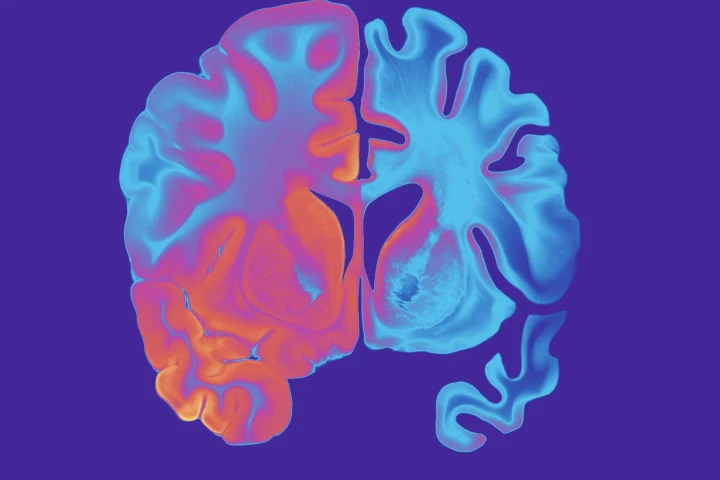




One of the biggest mysteries in neuroscience is why women account for nearly two-thirds of Alzheimer’s disease cases. Now, we may be a step closer to understanding this phenomenon, with new findings that highlight an overlooked part of the brain that appears to fail as estrogen levels fall with age.
Northwestern Medicine researchers have demonstrated for the first time how the loss of estrogen – which significantly increases during menopause – leaves the space between brain cells known as the extracellular matrix (ECM) vulnerable. This vulnerability appears to largely impact an area of the brain responsible for memory.
Examining young and old individuals of both sexes in a mouse model, scientists found that older females with low estrogen levels in their ECM exhibited distinct signs that would translate to cognitive decline in humans. And given that memory is a key function impacted, it's no surprise that the loss of this hormone was prevalent in the ECM in the hippocampus.
“This study tells us that females – but not males – may be uniquely sensitive to loss of brain estrogen at old age, potentially contributing to an increased risk of Alzheimer’s disease,” says corresponding author Dr. Hong Zhao, a research professor at Northwestern University Feinberg School of Medicine.
If you've never thought much about the space between brain cells, you're not alone. For decades, scientists largely viewed the extracellular matrix (ECM) – the web-like scaffold surrounding cells – as more structural than functional. But recent research has revealed it plays a critical role in supporting neurons, maintaining brain plasticity, and helping cells communicate.
While the ECM – found throughout the body’s tissues and organs – has become a target in breast cancer research, its role in the brain is only now emerging as an important area of study.
As women enter menopause, estrogen production by the ovaries drops sharply. For some time, scientists have hypothesized that this hormonal shift leaves the brain more vulnerable to aging and neurodegeneration, but the biological mechanisms have eluded researchers.
In the new study, scientists examined how estrogen loss affects the aging brain, using mice genetically engineered to be unable to produce the hormone either throughout the body or in the brain itself. They then investigated if this lack of estrogen affected memory, behavior, and gene activity.
They found that in older female mice, where estrogen loss appeared to alter ECM activity in the hippocampus, the hormonal deficit triggered structural changes that could potentially disrupt brain cell communication.
But it's not all bad news; the findings open the door to developing new therapeutic targets for those most at risk of cognitive decline – women. Current Alzheimer’s disease (AD) treatments are largely focused on clearing amyloid plaque build-up, but restoring the brain's ECM could potentially shield the brain from damage once estrogen is scarce. This is not the first study to link menopause and the loss of estrogen with Alzheimer's disease, either.
What's more, the study also shines a light on hormone replacement therapy (HRT) and how poorly designed studies, misinformation, and highlighting risks have discouraged menopausal women from seeking support. While HRT studies have produced mixed results when it comes to brain health, the researchers add that variables such as age, dosage, and the type of hormone used in treatment have made it a challenging area of study.
“More research is needed to understand how estrogen affects the female brain and why estrogen loss increases AD risk in women,” Zhao says. “Understanding these mechanisms could help researchers develop safer and more effective HRT strategies to prevent or slow the progression of AD in women.”
What we do know is that women are disproportionately impacted by AD and memory loss as they age. The study highlights the need to understand how hormone deficiencies may drive irreversible cognitive degeneration – and, in turn, find ways to support brain health if the loss of estrogen is playing a key role in this decline.
“We have provided some of the most compelling evidence that estrogen is so important for memory function and other mood functions in the female brain,” says senior author Dr. Serdar Bulun, a Northwestern Medicine physician. “This should motivate clinicians to be more aware of the essential role of estrogen for women’s brains, because once memory is gone, it’s gone.”
The study was published in the journal Aging Cell.
Source: Northwestern University
Fact-checked by Mike McRae.