
Digital imaging
-
 An ongoing study is testing a new kind of neuroimaging device designed to easily capture brain activity in real-time. These experiments will investigate the effects of ketamine on functional connectivity in the brain before, during and after an experience.
 -
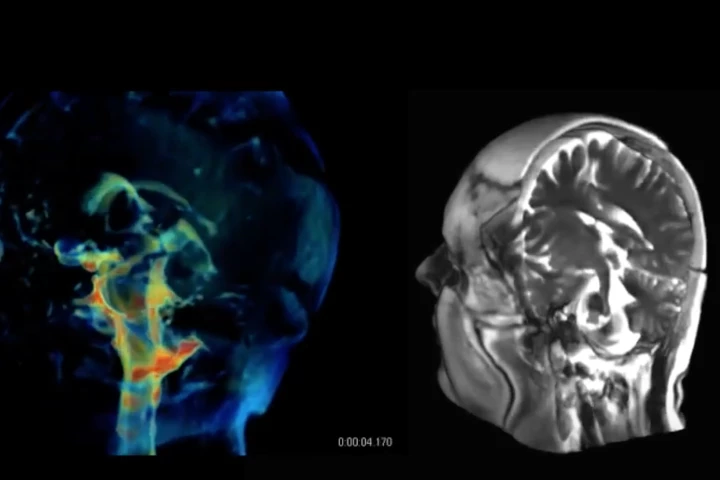 An imaging technique has been developed offering detailed 3D videos of a human brain. The technique offers novel perspectives on the motions of a brain, delivering clinicians a new diagnostic tool and researchers insights into neurological disorders.
 -
 A UK team has demonstrated a novel technology for imaging the brains of infants and babies. The breakthrough is hoped to allow researchers new ways to investigate baby brain activity in natural environments without the need for expensive MRI machines.
 -
 A team of researchers has made a surprising new discovery, finding a pair of previously unknown salivary glands. Nestled deep in the back of the nasopharynx, the discovery may help prevent damaging side effects from head and neck cancer radiotherapy.
 -
 An image comparing toxic protein accumulations in the brains of older subjects suffering cognitive decline to older, cognitively healthy subjects known as “super-agers” has won Image of the Year from the Society of Nuclear Medicine and Molecular Imaging.
 -
 Researchers from MIT have revealed the very first images of a human generated through a novel laser ultrasound imaging technique. Unlike conventional ultrasound, the new technique does not require any skin contact with the body.
 -
 An intriguing new study from Imperial College London is shedding light on how one of the world’s most powerful psychedelic substances alters brain activity, rapidly shifting a person’s brainwaves into a state that resembles dreaming.
 -
 We've seen before how Google is experimenting with its RAISR algorithm to add detail and sharpness to images, but a new paper from a team of Google Brain researchers shows how machine learning might take things to a whole new level.
 -
 CERN is digitizing over 50 years of old photographs. However, the researchers say they can’t work out what some photos depict. If you know your Large Hadron Collider from your Low Energy Antiproton Ring, then be sure to read on and lend a hand ...
 -
 Astronomers from the Sloan Digital Sky Survey have just made the largest ever digital color image of the sky available to the scientific community and the public alike.