

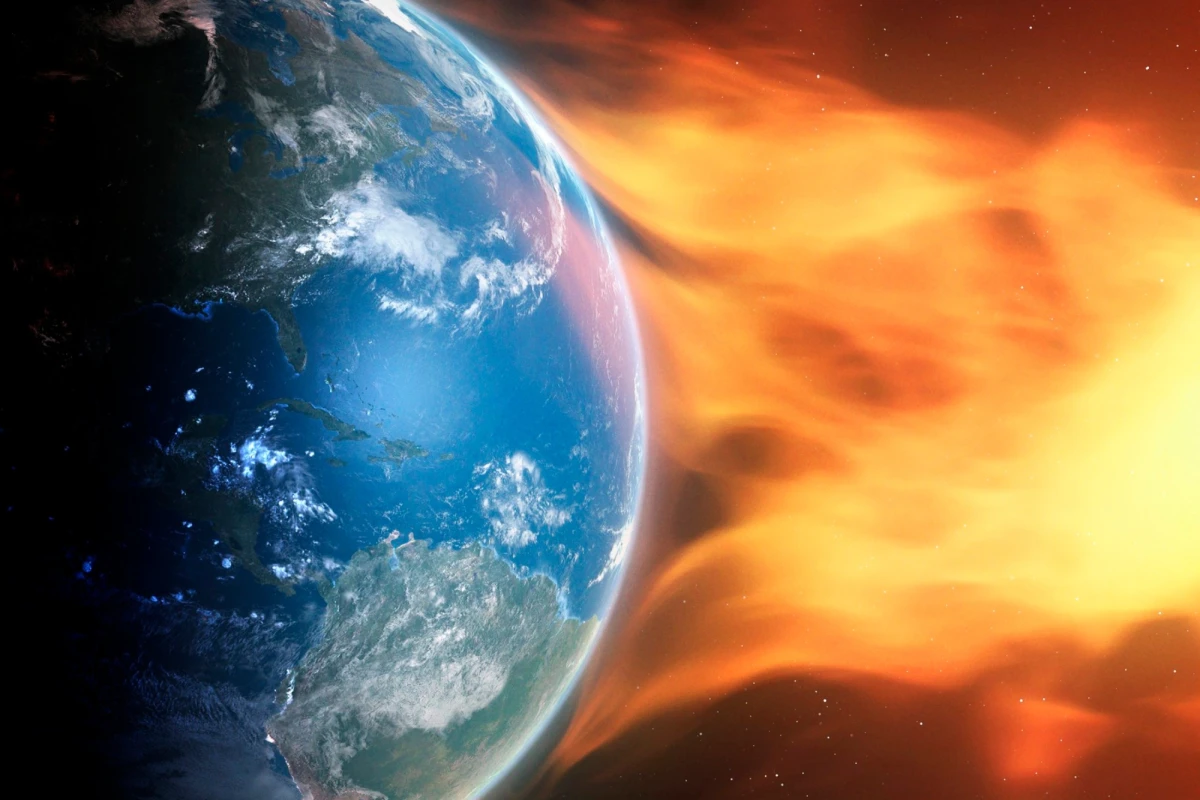

A theorized limit to our planet’s response to geomagnetic storms may be the product of a statistical illusion, researchers claim, revealing that the extent of damage from the most extreme solar events could be greater than we ever imagined.
According to a recently published argument made by a team of NASA-led scientists, suggestions that Earth’s geomagnetic activity has a “saturation point” may be based on a misinterpretation of the data. The true impact of a monster solar event could be twice as bad as our current expectations.
Every now and then, our Sun emits a puff of plasma in what is known as a coronal mass ejection. Consisting of powerful, charged particles moving at speed, such solar flatulence would be a cosmic case of “silent but deadly” if not for the fact that Earth’s surface sits beneath a magnetic umbrella.
That doesn’t mean we’re completely immune to any effects. Plasma zipping along magnetic fields high overhead can induce electromagnetic mayhem, generating currents that threaten everything from satellites to power grids.
Early one September, in 1859, Earth was struck by what is now regarded as the most powerful geomagnetic storm on record. Known as the Carrington Event, it overwhelmed sections of our burgeoning technology, sparking a handful of fires in a few telegraph stations.
The next big one may not be so kind to us, so researchers are keen to know just how bad these events can get down here on the surface.
To estimate the risk posed to our modern world of circuits, microchips, and wiring, researchers have combined observational studies on geomagnetic activity using magnetometers at the planet’s poles with measures of the solar wind delivered by far-distant probes.
As the data piled up, the relationship between solar storm strength and cross-polar measurements started to look more curved than linear, as if there was a ceiling to the extent of geomagnetic activity.

Scientists came up with a bunch of possible explanations. Could oscillations in the charged particles impose some kind of cap on the movement of particles? Maybe the rate of reconnection between field lines drops under the right conditions? Or perhaps the dynamics of the plasma’s pressure constrain the currents?
Going back to the data itself and correcting for uncertainties, the team behind this latest study found the graph's curve could be better explained by a statistical phenomenon. That means there may be no ceiling after all, at least not one set by any hypothetical quirks in the mechanics of our magnetic field.
The phenomenon, known as regression to the mean, is a common sticking point in statistics.
“This effect is particularly pronounced for uncertain measurements of extreme values and is likely to manifest across various fields, from extreme climate studies to chronic medical pain,” the team writes in their report.
Randomly select an event from a list of events, and it’s likely to be fairly average. Not a sizzler, not a fizzler. If that random pick just happens to be an extreme “1-in-a-100” example, the next selection has a high chance of being comparatively normal. Each selection regresses to the mean.
This seems pretty straightforward. The problem arises when samples are more random than we presume.
In this case, the sample is a measurement of the solar wind as it speeds towards Earth. There’s a high level of uncertainty in the timing and magnitude of these events, which the team argues hadn’t been adequately taken into account.
When considered, the “true” measures of the wind ought to be less extreme, suggesting there’s plenty of room left for a truly powerful solar storm to shake our geomagnetic roof.
"Correcting for the uncertainties reveals that the Earth’s response to solar wind driving is linear throughout, and that the impact of extreme geomagnetic storms can be twice as large as previously thought," the researchers conclude.
This research was published in the journal Nature.
Source: NASA
Fact-checked by Bronwyn Thompson