



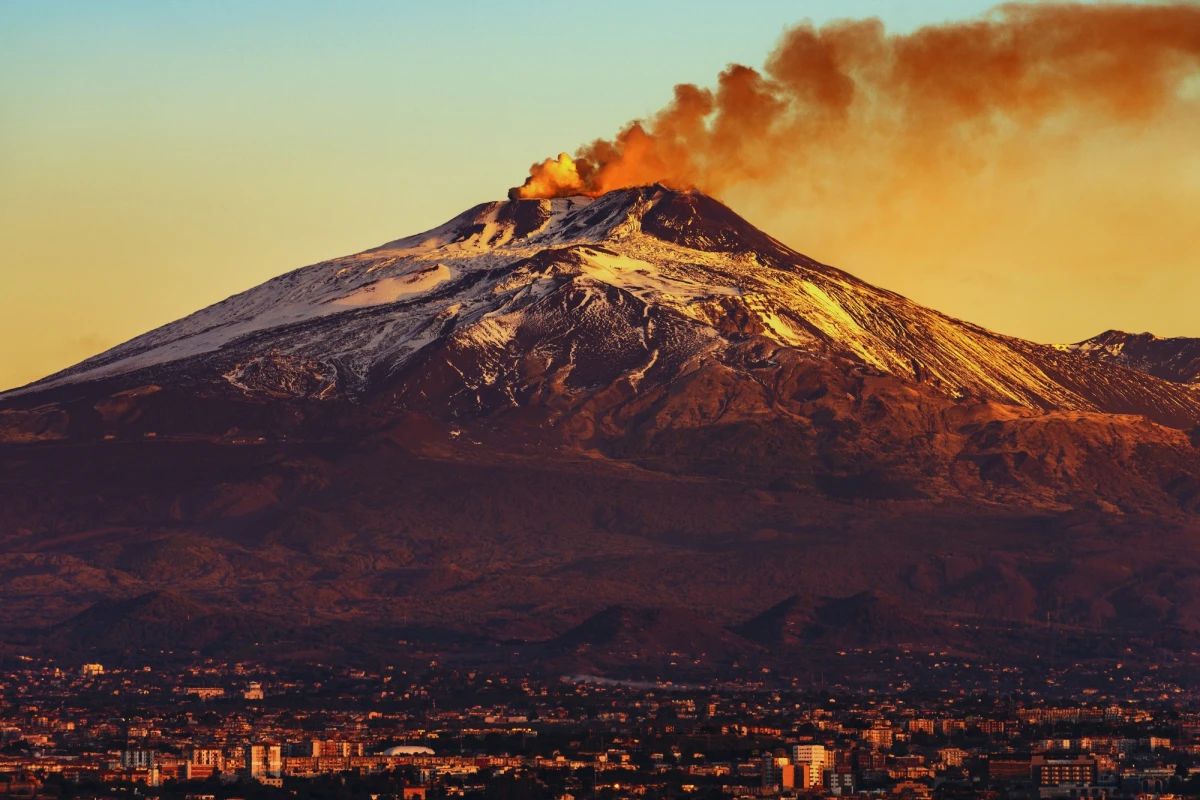

Europe's most active volcano, Mount Etna, has always been a geological puzzle. The Sicilian volcano has erupted several times a year, and glassy peaks of over 3,000 meters (10,000 feet) have fascinated scientists for decades. Though renowned, Etna has stubbornly defied categorization in the traditional volcano lifecycle.
Now, a group of researchers at the University of Lausanne (UNIL), in collaboration with their colleagues from Italy's Istituto Nazionale di Geofisica e Vulcanologia (INGV), is putting forth another wildly contested explanation.
The work published in the Journal of Geophysical Research – Solid Earth indicates that Etna could have formed through a unique volcanic process previously only identified in small submerged volcanoes.
If verified, Etna would become a geological one-off: a colossal stratovolcano nourished by a mechanism that bears no resemblance to any other large volcano on Earth.
Traditionally, volcanoes are grouped into three types: Mid-ocean ridges, where plates pull apart and mantle material rises; Subduction zones, where one plate sinks beneath another and produces volcanoes like Mount Fuji; and hotspots, where plumes of abnormally hot mantle make chains of islands such as Hawaii.
Etna sits near a subduction zone, yet its lava chemistry resembles hotspot volcanoes. No hotspot exists beneath Sicily, leaving scientists puzzled.
The UNIL team proposes that Etna is fed by pre-existing pockets of magma stored in the upper mantle's Low Velocity Zone (LVZ), about 80 kilometers below the surface. These melts don't form just before eruptions, as in most volcanoes. Instead, they linger for long periods until tectonic forces squeeze them upward.
"As the tectonic plate bends near the subduction zone, fractures develop, allowing the magma to rise through the crust, much like liquid being squeezed from a sponge," the researchers explain.
Lead author Sébastien Pilet adds: "Our study suggests that Etna may have formed through a mechanism similar to the one that generates petit-spot submarine volcanoes. This is unexpected, as such processes had previously only been observed in very small volcanic structures, typically rising no more than a few hundred meters. Mount Etna, by contrast, is a large stratovolcano, whose activity began around 500,000 years ago and which now towers more than 3,000 meters above sea level."
Petit-spot volcanoes were first identified off Japan in 2006. They are tiny compared to Etna, but they provide evidence for magma pockets near the lithosphere–asthenosphere boundary. Etna may be the first large volcano formed by this same process.
The team investigated rock samples from half a million years of eruptions to look into Etna's origins. The results showed that the geochemistry of magma in Etna, for the most part, has remained surprisingly consistent over time, even though tectonic shifts have occurred in the region.
This would be consistent with the idea that this volcano is fueled by stably residing mantle melts as opposed to transient magmas generated by subduction or hotspots.
If Etna truly belongs to this "fourth category" of volcanism, it could reshape how scientists think about magma sources and volcanic hazards. It also makes Etna a unique natural laboratory: a place where the compositions of melts at the lithosphere–asthenosphere boundary can be studied directly at Earth's surface.
The results may help improve hazard assessments in Sicily, where Etna eruptions threaten adjacent communities. Conversely, they argue that these geologists should actively keep an eye peeled for such processes in other locations, possibly revealing other secreted "petit-spot giants."
This research was published in the Journal of Geophysical Research – Solid Earth.
Source: University of Lausanne
Fact-checked by Mike McRae


