
University of Warwick
-
 If you feel your morning coffee puts a spring in your step, science has your back. In the first large-scale real-world study of its kind, researchers found that caffeine can significantly improve mood under certain conditions – especially in the morning.
 -
 Most of us do it, in one form or another, but how and when humans began to kiss is still hotly debated among researchers. Now, a new evolutionary theory has been put forward, which says the origins of the kiss may date back millions of years.
 -
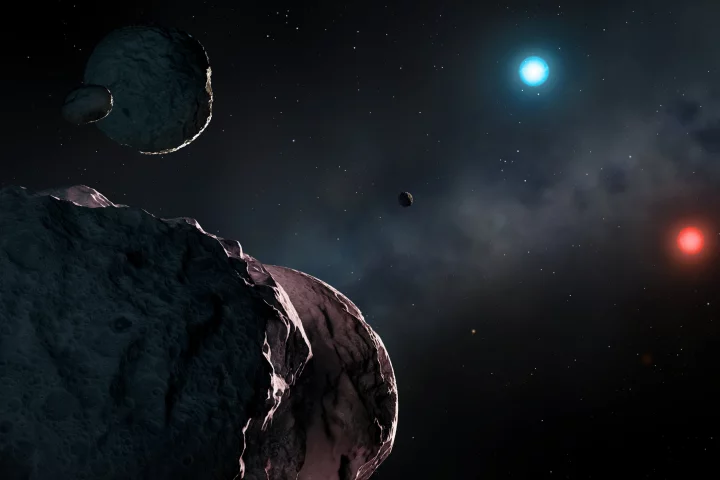 Planets have been born, lived and died long before Earth even existed. Now astronomers have detected the ruins of ancient planets around two unusual white dwarf stars, including an Earth-like world that existed almost 10 billion years ago.
 -
 In what's described as a key advancement for the future of systems that could help propel humans into deep space, scientists have demonstrated a method of extracting oxygen from water in microgravity using magnetism.
 -
 Some cells can turn cancerous when they divide, due to chromosomes getting “lost” in the process. Researchers have now uncovered what happens to these lost chromosomes and how to recover them, potentially leading to ways to prevent certain cancers.
 -
 Whether it occurs in a car, plane, boat or VR environment, motion sickness is no fun. According to new research, though, it's possible for people to "train their brain" out of the condition, potentially reducing the symptoms by more than half.
 -
 For the first time, astronomers have used a machine learning algorithm – a form of self-teaching AI – to confirm the existence of 50 new exoplanets in data collected by the now retired Kepler space telescope.
 -
 A Medieval medical book hold the key to new ways to combat antibiotic-resistant bacteria. Scientists have found that a medical recipe from the ancient Bald's Leechbook is effective against five strains of bacteria that cause biofilm infections.
 -
 It goes without saying that as a chemist stirs a solution in their lab, they need to check how its characteristics change. A new "Smart Stirrer" has been designed with that in mind, as it automatically detects and reports transformations.
 -
 A supernova may seem like a pretty final fate, but now astronomers have discovered a star that apparently survived this explosive process. It wasn’t without consequence, however – the star was kicked out of a binary orbit and flung across the galaxy.
 -
 A team of researchers recently presented a font called Sans Forgetica, claiming it helps enhance memory. UK and New Zealand researchers have now put the font to the test, and reveal, while it may be difficult to read, it doesn't enhance memory.
 -
 British engineers are developing a modern version of the Negative Pressure Ventilator (NPV), more popularly known as the "iron lung," to provide COVID-19 patients under the care of the NHS with a simple, inexpensive alternative to ventilators.
Load More