
University of California Santa Barbara
-
 Upending long-held beliefs that testosterone levels fuel sexual desire, a new study has found that while the hormone plays a key role in reproductive success, elevated concentrations may instead drive 'courtship' efforts – particularly in single men.
 -
 Genetic studies have revealed that when male mosquitoes lose their hearing, they also lose their sex lives. The surprising discovery could lead to new ways to reduce mosquito populations and the diseases they spread.
 -
 Human stem cells can differentiate into any human cell. But dedifferentiation, differentiation in reverse, is implicated in several diseases. Now, researchers have uncovered a mechanism key to the process of stem cell dedifferentiation.
 -
 Google has announced that it has achieved “quantum supremacy,” the point where a quantum computer successfully performs an operation considered impossible for traditional computers. But rival IBM disagrees that this has been achieved at all.
 -
 In what may be seen as a worrying development to those troubled by the growth of the surveillance state, researchers at the University of California have demonstrated that they can count people through walls using only Wi-Fi signals.
 -
 According to new research, the colossal caldera of the Yellowstone supervolcano was created by not one, but two powerful and closely spaced eruptions that took place some 630,000 years ago. The eruptions were powerful enough to affect the global climate as the planet was recovering from an ice age.
 -
 Thanks to a global network of 18 robotic telescopes, researchers caught a brief blue glow in the sky which, they say, was the result of a different kind of supernova explosion. The find reveals surprising information about the companion star next to the white dwarf that sparked the spectacle.
 -
 Three years ago, scientists used Wi-Fi-equipped ground-based robots to obtain 2D images of objects hidden behind brick walls. Now, using aerial drones, they've obtained 3D images of similarly-hidden objects.
 -
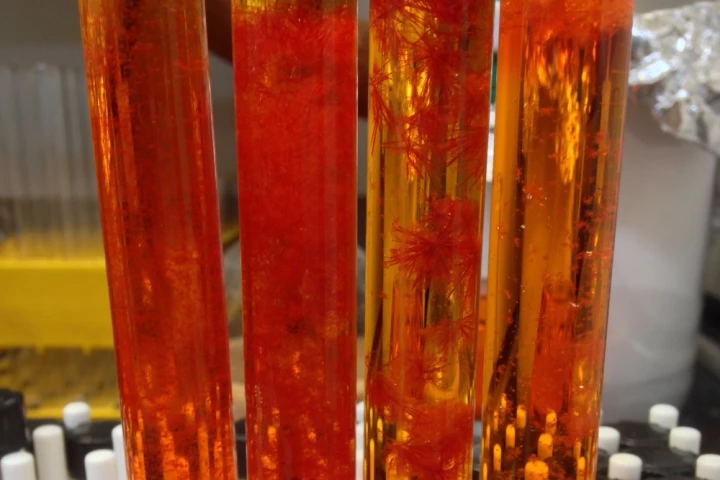 The bacteria Shewanella oneidensis is useful for cleaning water and generates electricity while it chows down. Now, researchers at UCSB have chemically modified the bacteria to increase its energy production, which could lead to wastewater treatment plants that generate some of their own power.
 -
 With various “de-extinction” projects in the works right now, researchers have published a paper analyzing the ecological benefits, risks and responsibilities of reintroducing once-extinct species into modern ecosystems.
 -
 A poorly functioning placenta is a problematic one as doctors are unable to treat it with drugs and are instead forced to induce labor early. But scientists have now found a way in by using existing cancer drugs that mistake the placenta for a tumor and boost its health.
 -
 Physicists working at the University of California Santa Barbara (UC Santa Barbara) claim to have created breakthrough circuitry that continuously self-checks for inaccuracies to maintain the error-free status of the quantum memory and may help accelerate the development of quantum computers.
Load More