
Transistor
-
 Researchers have used off-the-shelf components to create a sensor device that is not only cost-effective but can quickly detect 32 different pathogens and has sensitivities on par with the state-of-the-art biosensors used in pathology labs.
 -
 Scientists at Columbia University have developed flexible, functional, waterproof transistors. These could find use in building miniaturized medical sensors, brain-machine interfaces, or long-term implants.
 -
 A new graphene-based sensor has been developed that can quickly and easily detect DNA mutations associated with a range of cancers and other life-threatening illnesses. It is envisaged that the sensor will eventually be implantable, and communicate data wirelessly to mobile devices in real-time.
 -
 Researchers at Harvard University's School of Engineering and Applied Sciences have invented a new type of transistor that can learn, potentially enabling a new approach to artificial intelligence by copying the way our brains work.
 -
 Researchers at NASA and the National Nanofab Center in South Korea are working on a vacuum channel transistor that can combines the best traits from transistors and vacuum tubes.
 -
 Three-dimensional transistors made out of indium-gallium-arsenide could result in much faster and lighter computers.
 -
 Squids have provided the key ingredient for a proton-conducting transistor, that may allow man-made devices to communicate with living systems.
 -
 Scientists from the Instituto de Microelectrónica de Barcelona have found a way to implant minute silicon chips into living cells and use them as intracellular sensors.
 -
 Dutch researchers developed a way to store electronic spin information into silicon, which could then be manipulated by a new spintronics transistor developed by Toshiba.
 -
 A single-atom transistor developed by Australian and Finnish scientists could prove extremely useful in the search of a better quantum bit for the next generation of personal computers.
 -
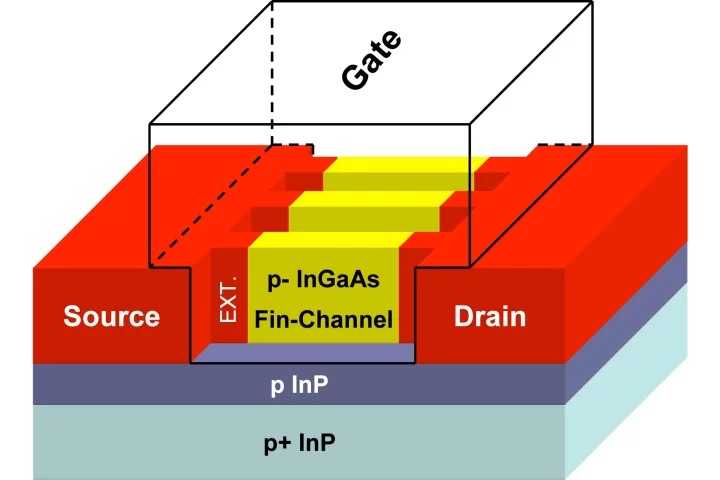 Researchers at Purdue University have made important progress in developing finFET transistors that could one day take the place of traditional MOSFETs.