
Touch
-
 For millions, losing their sense of smell reshapes daily life. Once damaged, the system is difficult to restore. That challenge led researchers to stop asking how to fix smell, and start asking whether its information might reach the brain another way.
 -
 In a first, scientists believe they have confirmed we have another sense – a “remote touch” that we share with others in the animal kingdom, like some shorebird species that can sense prey beneath sand without seeing or touching it first.
 -
 Touch is a vital sense in human survival and experience, yet not all touch is equal. Men have less touch sensitivity than women, which comes down to biology. Using biomechanics, scientists have found that you can hack nature with hyaluronic acid.
 -
 When we’re given a choice about where we want to be touched, the touch is significantly more pleasurable, a new study has found. The findings have implications for interpersonal relationships, communication, health and well-being.
 -
 A touch-sensitive protein normally located in the skin has now been found in the gut. It senses the presence of food and triggers contractions to push it along, while reduced levels of this protein may be implicated in conditions like constipation.
 -
 The 2021 Nobel Prize in Physiology or Medicine has been awarded jointly to David Julius and Ardem Patapoutian, for their work uncovering the receptors that allow us to perceive temperature and pressure.
 -
 When someone injures a nerve in a body part such as a finger, it's not uncommon for that part to end up with a permanently decreased sense of touch. A self-powered implantable sensor, however, could one day restore sensitivity to such injured areas.
 -
 Although we've already heard about pressure-sensitive "skins" that could be applied to robotic appendages, scientists have created one for use on human fingers. And while you might wonder why they bothered, it actually has an interesting application.
 -
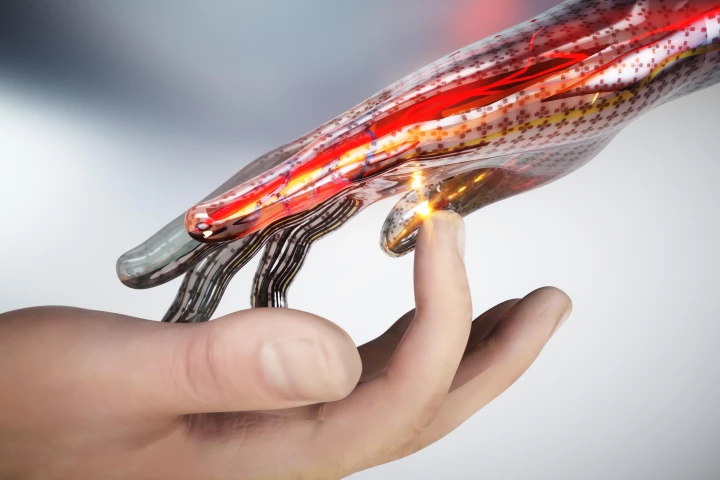 Researchers in Australia have succeeded in developing an artificial skin that responds to painful stimuli, heat and pressure like real skin does, which they see as an important step towards intelligent machines and prosthetics.
 -
 A new "artificial skin" simulates a sense of touch via tiny air bladders.
 -
 It was just last year that we heard about the Fundamental Surgery simulator, which utilizes dual haptic feedback arms to provide the "feel" of performing various surgical procedures. The system has now been taken a step further, with the demonstrated integration of whole-hand VR gloves.
 -
 Researchers at Caltech have induced a range of sensations in the arm of a paralyzed man. Electrodes implanted in the brain stimulated the neurons to produce different feelings. The research could eventually lead to prosthetic limbs that allow users to feel realistic sensations through them.
Load More