
Supercomputer
-
 Got asthma? Then you might also go on to get Parkinson's. Celiac? You'll want to watch out for lung cancer. That's the kind of information you can get on a new website that uncovers the links between common conditions based on genetic analysis.
 -
 Teams tasked with managing tsunami risks may soon have a powerful new tool at their disposal, in the form of a new AI model that enables near real-time predictions of how these events will shape the flooding of coastal areas.
 -
 Google has announced that it has achieved “quantum supremacy,” the point where a quantum computer successfully performs an operation considered impossible for traditional computers. But rival IBM disagrees that this has been achieved at all.
 -
 Science may be entering a golden age of climate modeling as high-resolution simulations of the global climate become possible and local extreme weather events in particular get more accurately simulated.
 -
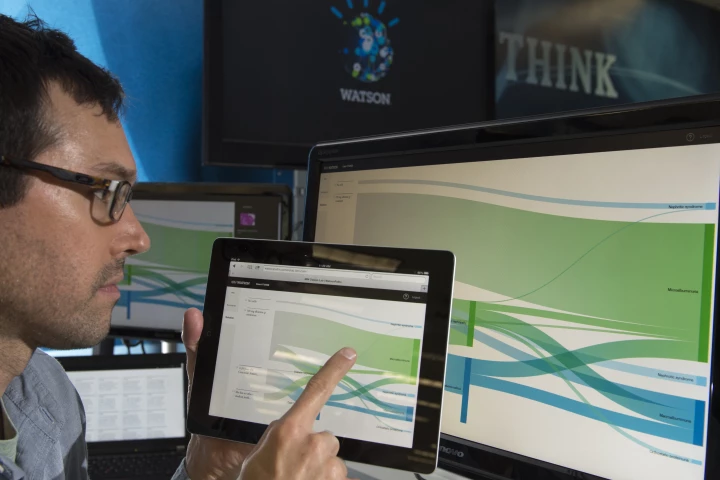 When IBM’s Watson supercomputer took on two human champions of the quiz show Jeopardy and won, it was hailed as a breakthrough in machine intelligence. Now in an effort to expand the practical applications for Watson, IBM and has revealed two new projects aimed at the medical community.
 -
 The Nobel Prize in Chemistry was awarded this morning to Martin Karplus, Michael Levitt, and Arieh Warshel for the development of multi-scale computer models of chemical reactions, the foundations for today's ubiquitous computational chemistry programs.
 -
 IBM's Watson supercomputer is going to Rensselaer Polytechnic University where it will be the object of Artificial Intelligence (AI) research and will (virtually) attend courses in English and math to hone its analytic skills.
 -
 IBM researchers have used the world's most powerful supercomputer to simulate a virtual brain comparable in complexity to that of a human.
 -
 The Oak Ridge National Laboratory (ORNL) has introduced Titan, the world’s most powerful supercomputer.
 -
 Scientists at Harvard University and the Heidelberg Institute for Theoretical Studies have developed a method for simulating the evolution of the Universe that produces realistic galaxies.
 -
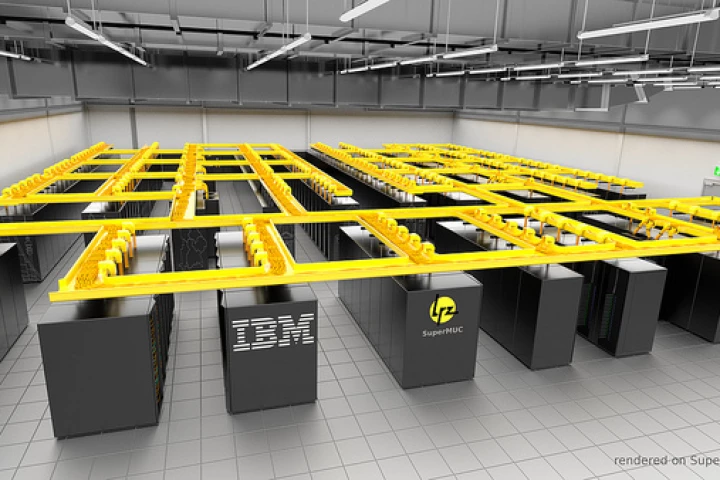 IBM's SuperMUC supercomputer, the fastest in Europe, has been developed alongside an innovative hot water-cooled mechanism that is 40 percent more energy-efficient than air-cooled technology.
 -
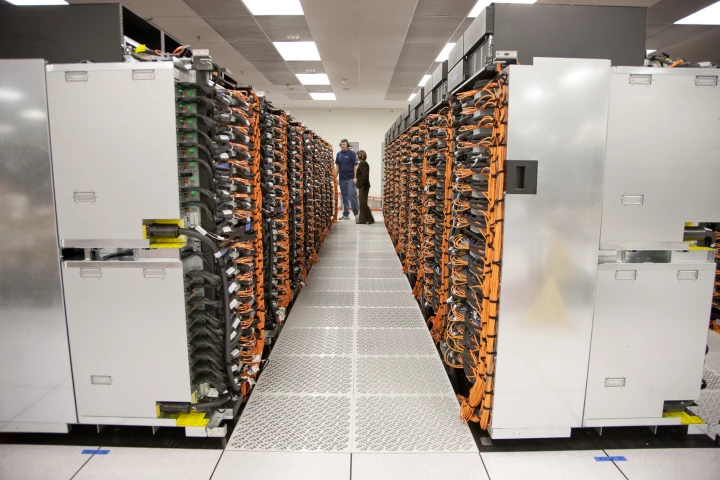 Clocking a performance of 16.32 petaflop/s, IBM's Blue Gene/Q-class supercomputer Sequoia has become the fastest supercomputer in the world according to the latest TOP500 rankings released today.
Load More