
SLAC
-
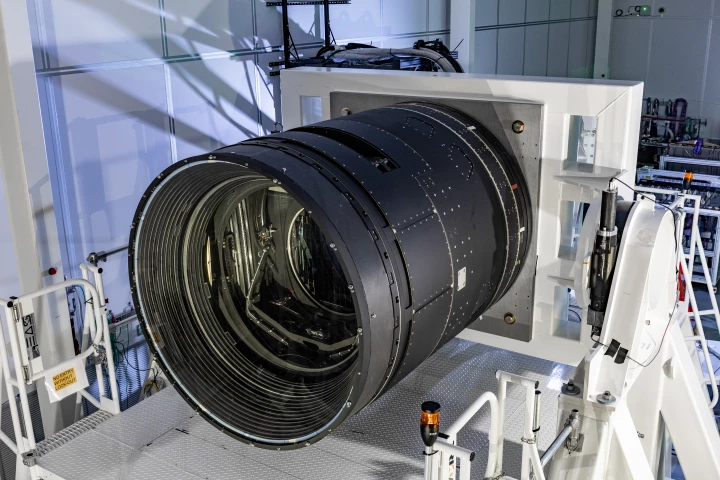 After decades of planning and building, the world's largest digital camera at the heart of the Vera C. Rubin Observatory on the summit of Cerro Pachón in Chile has snapped its first imagery – from test observations spanning a 10-hour window.
 -
 Researchers have combined two microscopic imaging techniques in one microscope, providing scientists with a high-resolution method of tracking single molecules in a cellular context, letting them visualize, in minute detail, what’s happening inside cells.
 -
 The SLAC National Accelerator Laboratory has switched on the world's most powerful X-ray laser. The Linac Coherent Light Source II X-ray Free-Electron Laser (XFEL) flashes a million times a minute and is 10,000 times brighter than its predecessor.
 -
 The world’s most powerful X-ray laser is ready for operation after a massive overhaul. The upgraded LCLS-II uses temperatures colder than deep space to accelerate electrons to near light-speed and fire off a million X-ray bursts per second.
 -
 Although it should be extremely common in the universe, dark matter has proven tricky to detect. Now researchers have proposed an intriguing new method to spot it – looking for shock waves as dark matter “asteroids” collide with stars.
 -
 The Linac Coherent Light Source (LCLS) is an extremely powerful X-ray laser – and now it's about to get even more powerful. The second generation of the instrument has now achieved first light, with scientists demonstrating fine control of the beam.
 -
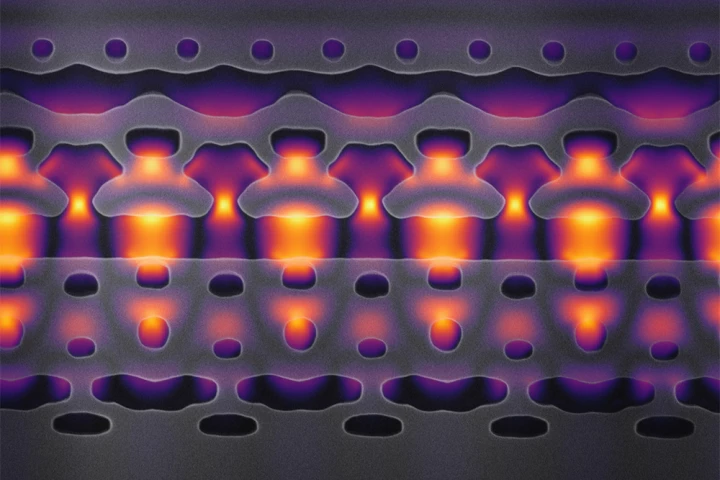 Particle accelerators could be incredibly useful for medicine – if they weren’t so huge. Now, scientists at Stanford have managed to shrink the tech down to fit on a computer chip, which could lead to more precise cancer radiation therapies.
 -
 Physicists at Stanford and the SLAC National Accelerator Laboratory have narrowed down the search for dark matter. Using observations of galaxies orbiting the Milky Way, the team found that dark matter is likely lighter than previously thought – and interacts even less with normal matter.
 -
 A team led by Gabriel Blaj, a staff scientist at the SLAC National Accelerator Laboratory and Stanford University, has generated what may be the loudest possible underwater sound.
 -
 Waiting for water to boil is a minor inconvenience that we’ve all experienced. Maybe next time try the world’s most powerful X-ray laser, which has now been used to boil water to 100,000° C in 75 millionths of a billionth of a second, turning it into a new plasma-like state of matter in the process.
 -
 The world’s most powerful X-ray laser, the Linac Coherent Light Source (LCLS), is about to get far more powerful. The first of 37 “cryomodules” has arrived at Stanford University’s SLAC National Accelerator Laboratory, which will boost the speed and power of the facility.
 -
 Gemstones might not seem so valuable if they literally rained from the sky, but that's thought to be a common weather pattern on ice giant planets. Now scientists at the SLAC National Accelerator Laboratory have seen it in action here on Earth, by making it rain diamonds in the lab.
Load More