
Saturn
-
 According to NASA, Saturn's moon Titan may be the most fantastically large slushie of all time. Based on a reexamination of data from the Cassini probe collected in 2012, the moon's long-suspected global ocean may actually be a slurry of ice and rock.
 -
 Saturn’s rings are iconic, but new evidence presented by researchers from Monash University suggests Earth might once have sported one of its own. This ring would likely have caused climate chaos on the surface.
 -
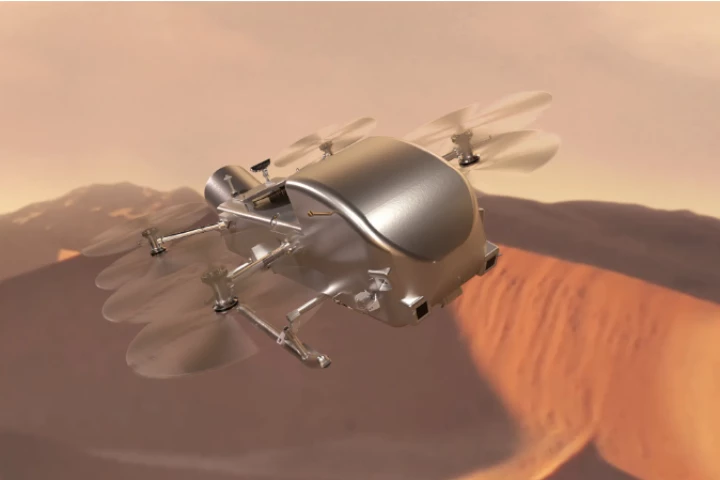 NASA has given the green light for the nuclear-powered Dragonfly rotorcraft to explore Saturn's largest moon, Titan. Approval for the 2028 interplanetary mission comes after years of delay due to COVID-19 and a series of cost overruns.
 -
 Although Saturn's moon Enceladus and Jupiter's moon Europa both have ice-covered surfaces, oceans may exist beneath that ice. The TRIPLE-nanoAUV 2 project is aimed at getting an uncrewed submersible into those oceans, to search for life.
 -
 A new discovery has boosted the chances of life soon being found on another world. NASA has announced the detection of phosphorus, the rarest element that’s essential to life, in the oceans of Saturn’s moon Enceladus.
 -
 Saturn’s moon Enceladus is famous for its plumes that spray water into space. Now the James Webb Space Telescope has watched the biggest known plume so far, spanning thousands of miles, and studied how they feed a huge water “donut” around Saturn.
 -
 Saturn has overtaken Jupiter as the planet with the most known moons in the solar system. Astronomers have announced a bumper crop of 62 new moons orbiting the ringed planet, pushing its total to well over 100.
 -
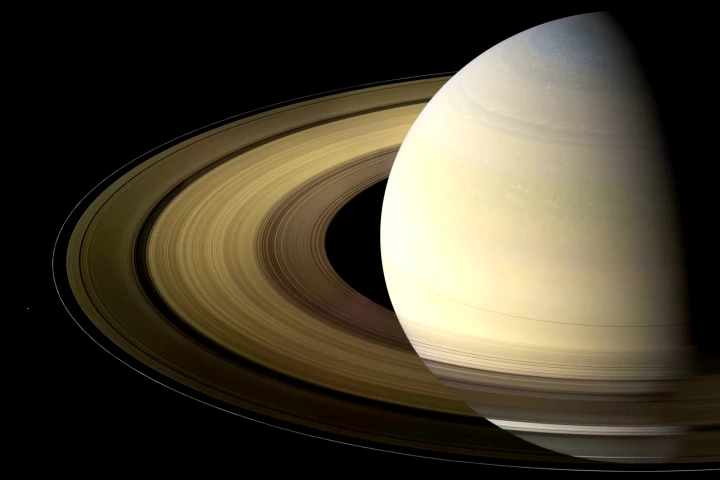 Saturn is renowned for its rings, easily visible through an ordinary telescope. Now, using observations collected over 40 years, scientists have discovered a never-before-seen interaction between the planet and its iconic rings.
 -
 Saturn is home to several solar system mysteries. Using data from Cassini, astronomers now suggest a simple answer to a few questions – a lost moon once orbited the planet before being torn to shreds.
 -
 Every year, the Hubble Space Telescope conducts a grand tour of the outer solar system planets, checking their turbulent atmospheres for changes in weather, storms, clouds and colors. This year’s shots are now in, revealing a few surprises.
 -
 Scientists have recreated in the lab some of the wild weather that might be found on Jupiter and Saturn. Using extremely high pressures and laser shock waves, the researchers produced helium rain which has been hypothesized to fall on these planets.
 -
 Researchers at the Paris Observatory's Institute of Celestial Mechanics and Ephemeris Calculation have found that the unusual tilt of Saturn's axis is due to the periodic gravitational pull of its moons over the last billion years.
Load More