
Quantum Mechanics
-
 The weak gravitational pull on a particle just half the mass of a grain of sand has been measured for the first time. This most precise measurement of its kind is a breakthrough towards the quantum realm and a potential Theory of Everything.
 -
 A unified Theory Of Everything is the holy grail of physics, but gravity refuses to play ball. A newly proposed theory attempts to unify Einstein’s theory of gravity with quantum mechanics – and importantly, outlines a way to test it experimentally.
 -
 Scientists have detected the first evidence of a phenomenon called “quantum superchemistry.” Long predicted but never confirmed, this effect could speed up chemical reactions, give scientists more control over them, and inform quantum computing.
 -
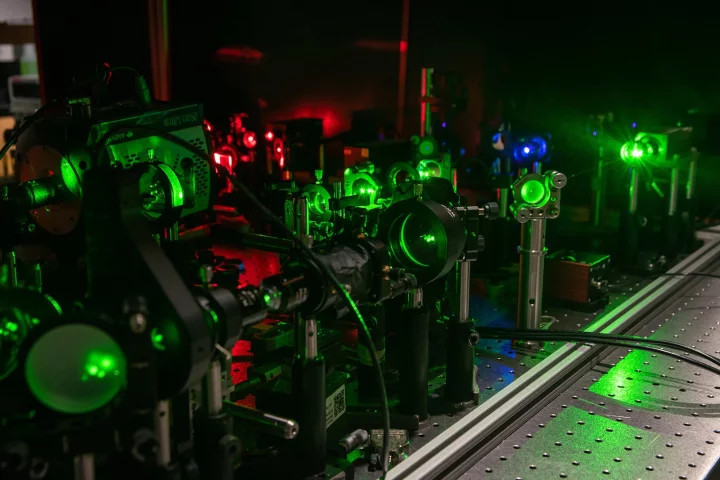 Caltech scientists have created a quantum microscope that taps into the quirky quantum rules to see tiny details much more clearly. Using pairs of entangled photons allows the instrument to double the resolution of images without damaging the sample.
 -
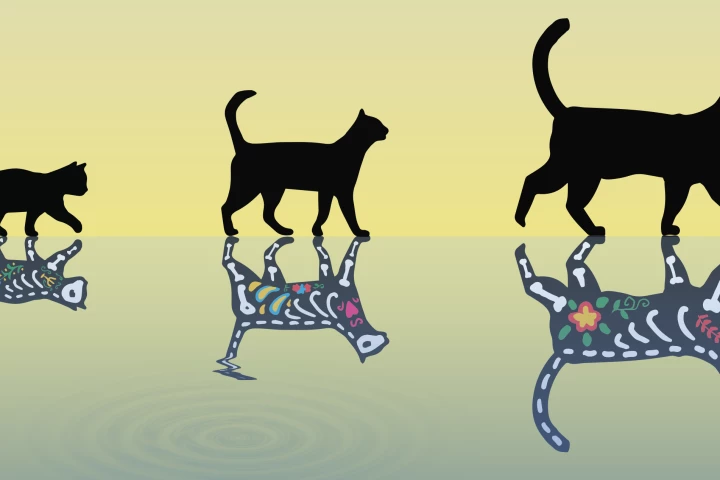 The famous thought experiment of Schrödinger’s Cat neatly sums up a complex quantum phenomenon in terms we can visualize. Now scientists have created the heaviest Schrödinger’s Cat to date, probing the boundaries between quantum and classical physics.
 -
 Wormholes are a sci-fi staple, and and it's possible that they exist in the real universe. But how would they work? Physicists have now used a quantum processor to simulate a traversable wormhole, teleporting information between two quantum systems.
 -
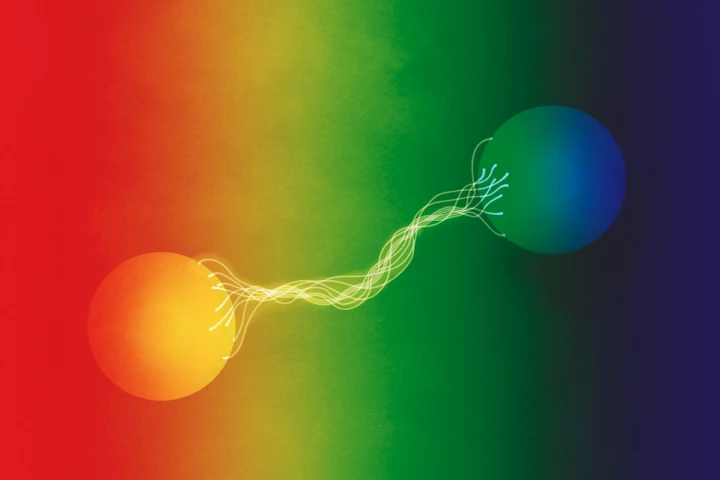 The 2022 Nobel Prize in Physics has been awarded to three scientists, Alain Aspect, John F. Clauser and Anton Zeilinger, who all conducted some of the first experiments with entangled photons, enabling a future for commercial quantum computers.
 -
 Physicists at the Max Planck Institute have developed an efficient new method to drive the quantum entanglement of photons, and demonstrated it by entangling a record number of photons. The technique could be a boon for quantum computers.
 -
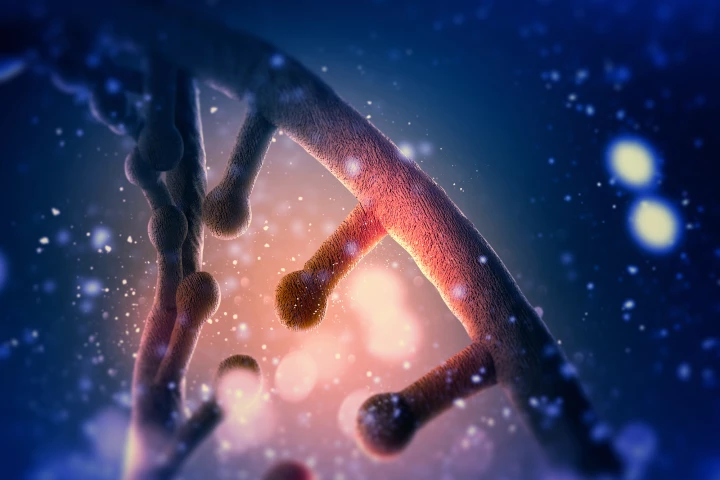 DNA mutates regularly, for better or worse, driving both evolution and disease. Researchers at the University of Surrey have now found evidence that some of these spontaneous mutations could be caused by the spooky realm of quantum mechanics.
 -
 The universe is governed by two sets of seemingly incompatible laws of physics – classical and quantum physics. MIT physicists have now observed the moment atoms switch from one to the other, as they form intriguing “quantum tornadoes.”
 -
 There are many exotic states of matter besides the basics of solid, liquid, gas and plasma. One of these, known as a supersolid, was confirmed a few years ago, and now University of Innsbruck scientists have created it in a new two-dimensional form.
 -
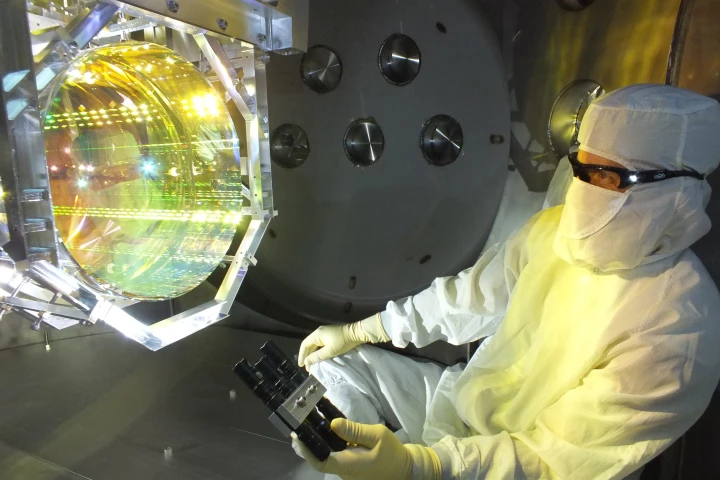 Classical physics describes how large objects and systems work on an everyday scale, while quantum physics describes the “spooky” subatomic world. Now scientists have observed a rare crossover where a quantum fluctuation affected a macroscale object.
Load More