
Perception
-
 Blinking isn’t just about keeping eyes moist. New research suggests we blink less when listening becomes hard, with each pause reflecting increased focus. The findings hint that blinking may track how hard our brains are working to listen among noise.
 -
 In a first, scientists believe they have confirmed we have another sense – a “remote touch” that we share with others in the animal kingdom, like some shorebird species that can sense prey beneath sand without seeing or touching it first.
 -
 Reading someone’s facial expressions or body posture is important for understanding their personality, emotions, motivations, or intent. But can dogs draw information from faces and bodies like we do? A new study has provided the answer.
 -
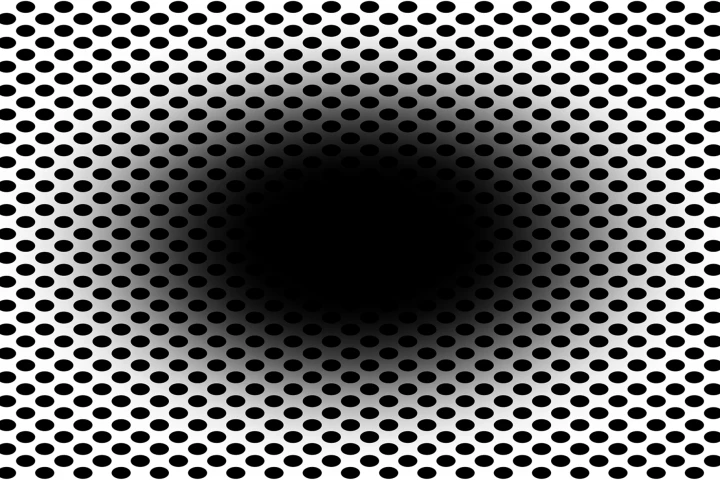 When you view the image above, does it look like black smear in the center is expanding? If it does, that means you're like most people – and your brain may even think that you're entering a tunnel, adjusting your eyes accordingly.
 -
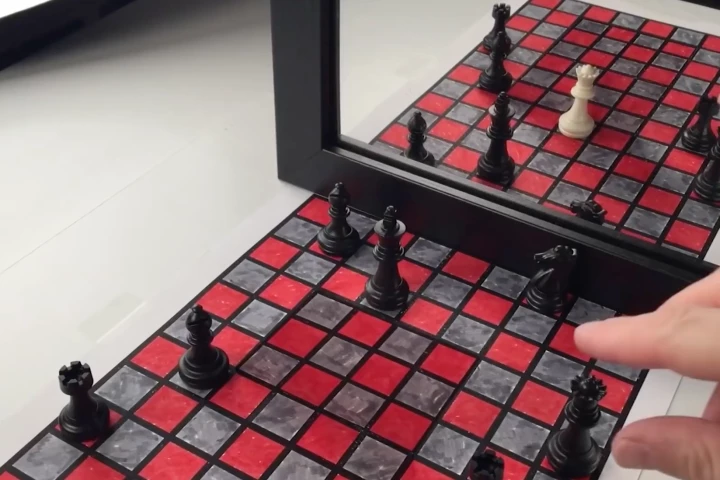 An innovative anamorphic illusion has taken the top prize in the annual Best Illusion of the Year contest. Twisting minds for 17 years the contest highlights the ways our brain can be tricked using simple perceptual illusions.
 -
 A tiny brain lesion can shift a person's reality in bizarre and tragic ways, and their ability to describe their condition can lead us toward a fuller understanding of how our complex mental processes work. Here's another oddity to put on the pile.
 -
 Austin-based game developer Frank Force has won the Best Illusion of the Year prize for his mind-bending yet simple animation of twisting rings that seem to be rotating in different directions simultaneously.
 -
 The subjective sense that time moves faster as we get older is a universal one, and over the years scientists have proffered a number of different explanations as to why this happens. A new and strange hypothesis attempts to explain the phenomena, and it has to do with our aging brains.
 -
 Researchers at Caltech have revealed two illusions illustrating how our brain can be tricked into seeing something that isn’t really there. The phenomenon is known as postdiction, and highlights how our perception of reality is actually constructed by our brain retroactively.
 -
 Us humans know that even if someone believes something, that thing may not in fact be true. According to new research, however, some of our fellow apes may likewise be aware that what people think doesn't necessarily mesh with reality.
 -
 Patients affected by neurological disorders and athletes facing severe exhaustion have all reported experiencing feeling an invisible and "presence" that is often felt just outside their field of view. Researchers at EPFL have now recreated the same sensations in laboratory experiments.