
Optics
-
 A new experiment has demonstrated something that sounds physically impossible – light itself casting a shadow. If you manipulate a laser just right, then hit it side-on with another light source, it’s possible to create this bizarre optical effect.
 -
 Scientists have manipulated light as though it was being influenced by gravity. By carefully distorting a photonic crystal, the team was able to invoke “pseudogravity” to bend a beam of light, which could have useful applications in optics systems.
 -
 Guiding lasers where they need to go is a key part of optics systems, and now engineers at DESY have developed a way to bend laser beams without anything touching them. The light is deflected using an invisible grating made of air shaped by acoustics.
 -
 All I wanted to do was get rid of my glasses, but when my local laser eye surgery clinic recommended some odd-sounding advanced Presbyond treatment developed by Zeiss, I said sure, if that's what the cool kids are getting. Here's what's happened.
 -
 Scientists in South Korea have created what they call "the world’s smallest ball game," throwing individual atoms between two optical traps. The research could eventually make for more adaptable and dynamic quantum computers.
 -
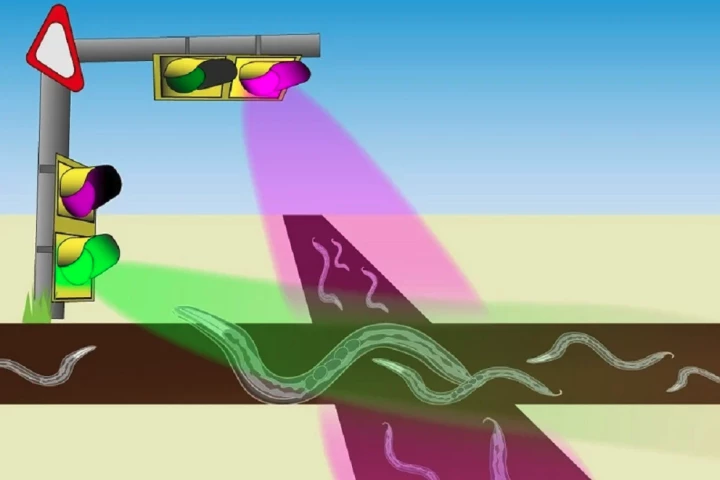 Scientists in Japan have demonstrated a technique that allows them to remotely control the movements of worms. By implanting light-sensitive proteins into the organisms, the team was able to make them move under green light and stop under UV.
 -
 Scientists have developed a way to produce a web of quantum entangled photons using a far more simple setup than usual. The key is a precisely patterned surface 100 times thinner than paper, which could replace a roomful of optical equipment.
 -
 Researchers have developed a more precise design for "optical tweezers," using a metasurface lens studded with millions of tiny pillars which focus light to trap and manipulate individual atoms. It could pave the way for powerful quantum devices.
 -
 A quantum internet could one day allow quantum computers to team up and tackle some gigantic problems. Researchers at Toshiba are a step closer, demonstrating quantum communications sent over a record-breaking 600 km (373 miles) of optic fiber.
 -
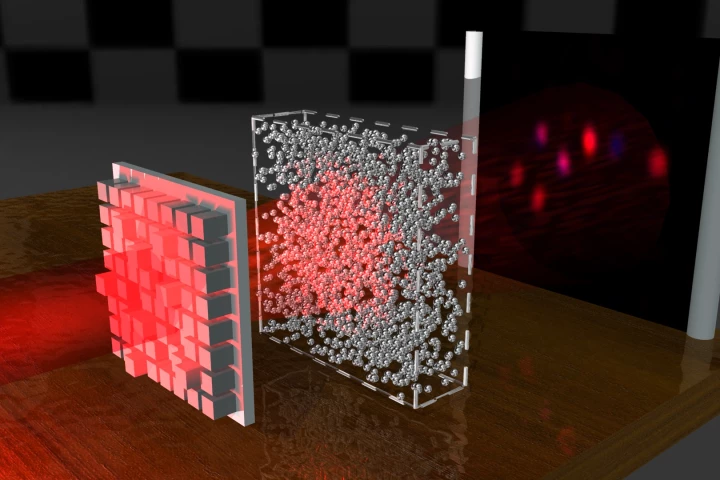 Clouds or sugar cubes block light because they’re disordered media that scatter light waves. Now scientists have found a way to manipulate light waves to pass through, projecting an image on the other side as clearly as if the obstacle wasn’t there.
 -
 An advanced microscopy technique has snapped “super-resolution” 3D images inside the brains of living mice. The method is so precise it imaged the tiny twigs on the branches of neurons, and could watch how they changed over the course of a few days.
 -
 An Australian/German team has developed the world's smallest imaging device, at the thickness of a human hair. It's capable of traveling down the blood vessels of mice, offering unprecedented abilities to 3D-scan the body at microscopic resolutions.
Load More