
Offshore Wind
-
 Back in August last year, Red7Marine joined a project led by Danish multinational Ørsted to design and install artificial nesting sites for threatened seabirds close to the Suffolk shoreline as part of the upcoming Hornsea 3 offshore windfarm project.
 -
 Siemens Gamesa has developed a fully recyclable blade that can be used to create new products when its wind-catching days are done, and it's just been installed on a turbine at a commercial wind farm in the North Sea.
 -
 A study by the University of Maryland indicates that new offshore wind farms being constructed on the Delaware-Maryland-Virginia coastal shelf could become a stopover spot for migrating Atlantic salmon and striped bass.
 -
 One of the biggest offshore wind farms in the world has just started turning in the North Sea, off the coast of the Netherlands. Hidden over the horizon, the Gemini wind farm isn't visible from the mainland or the neighboring islands, and is set to produce about 2.6 TWh of electricity every year.
 -
 A V164 offshore wind turbine from MHI Vestas Offshore Wind has produced almost 216,000 kWh over a 24-hour period during tests at its site near Østerild, Denmark in December. In doing so, the 9 MW prototype takes the energy generation record for a commercially available offshore wind turbine.
 -
 The UK Secretary of State for Energy has given approval for what will be the biggest offshore windfarm in the world. Hornsea Project Two is the second site of the Hornsea offshore project and will comprise up to 300 turbines with a total capacity of up to 1.8 GW.
 -
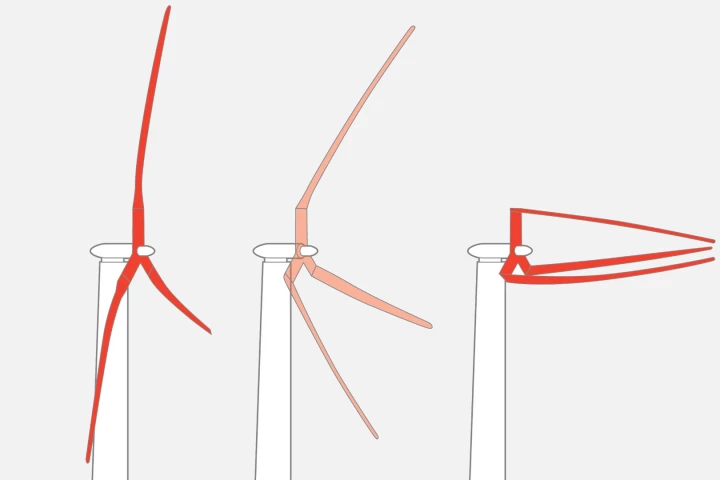 Sandia National Laboratories has revealed its plans for the extreme-scale Segmented Ultralight Morphing Rotor (SUMR). The turbines are built to deal with the extreme conditions of an offshore farm, featuring a folding build to cope with high winds.
 -
 Offshore wind generation is extremely effective, but it's also very expensive to anchor wind turbines to the sea bed using current technology. Seatower's very clever base platform is significantly cheaper and easier to fix to the ocean floor. It could make offshore wind power much more affordable.
 -
 Norwegian researchers have filed a patent to store potential energy at the bottom of the sea.
 -
 A new concept out of MIT aimed specifically at offshore wind turbines would see energy stored in huge concrete spheres that would sit on the seafloor and also function as anchors for the turbines.
 -
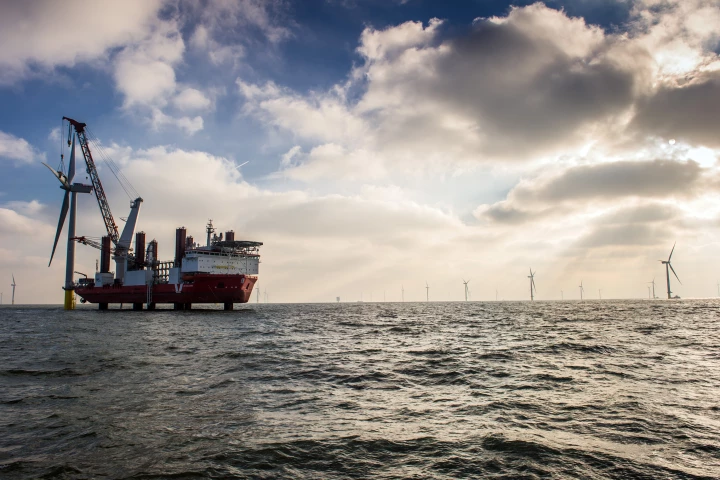 At 630 MW of installed capacity, phase one of the London Array usurped the UK's Greater Gabbard to become the largest operational offshore wind farm in the world when its final turbine (its 175th) was commissioned on Saturday afternoon.