
Metamaterials
-
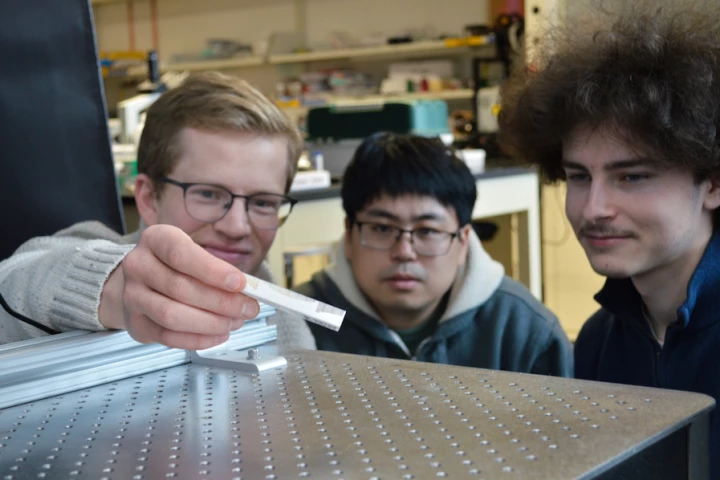 Engineers have developed a new system that can move objects without physical contact. The technique involves ultrasound waves acting on specialized surfaces to push or pull objects in set directions, which could help in manufacturing and robotics.
 -
 Researchers have developed a more precise design for "optical tweezers," using a metasurface lens studded with millions of tiny pillars which focus light to trap and manipulate individual atoms. It could pave the way for powerful quantum devices.
 -
 Most conventional light microscopes have a resolution of 200 nanometers – this means that imaged objects which are any closer together won't be seen as separate items. A new high-tech microscope slide, however, boosts that figure to 40 nanometers.
 -
 Ultra wide-angle fisheye lenses are typically thick, bulbous contraptions, that can't easily be incorporated into devices such as smartphones. That could be about to change, though, as engineers have now created one that's completely flat.
 -
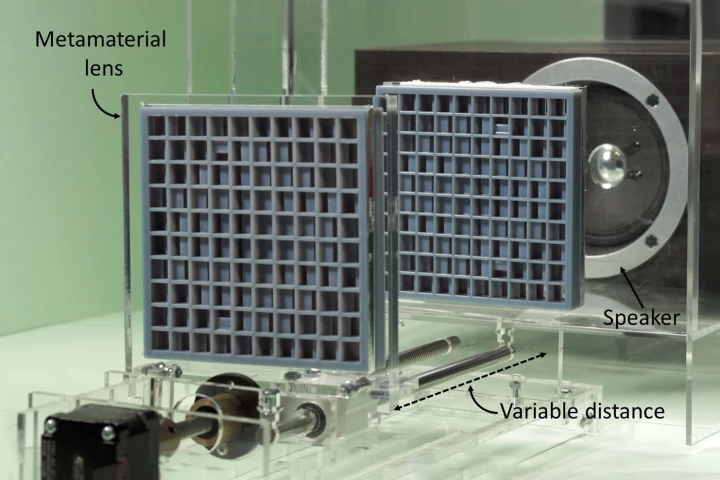 Imagine talking to someone across a crowd of thousands without using a phone, or sitting way up the back at a concert, but hearing everything perfectly. This is the promise of acoustic lenses, and researchers at the universities of Sussex and Bristol in the UK think they’ve something to shout about.
 -
 Researchers at the University of Utah have devised a method to create invisible images embedded within normal-looking images using cheap inkjet printers. The data hidden in these images can then only be revealed using sub-millimeter electromagnetic radiation
 -
 It's one of the basic facts of science: Heat something and it expands. But a team of scientists from LLNL have gone counterintuitive and invented a 3D-printed material that shrinks when heated.
 -
 Researchers have developed a lens that operates at terahertz frequencies that are not only simple and inexpensive, but are claimed to produce near-flawless images which could vastly improve biomedical imaging as well as biological and explosive security scanning.
 -
 Scientists at UC Berkeley have developed a foldable, incredibly thin invisibility cloak that can wrap around microscopic objects of any shape and make them undetectable in the visible spectrum.
 -
 Researchers working at NASA's Jet Propulsion Laboratory (JPL) and the California Institute of Technology (Caltech) have created a flat silicon metamaterial lens that controls the properties of light in ways that normal optical lenses cannot hope to emulate.
 -
 Using newly-developed metamaterials, scientists at the University of Buffalo have created a prototype "hyperlens" that may help image objects in visible light with dimensions so small that they were once only clearly viewable through electron microscopes.
 -
 A new technique involving complementary metamaterials allows high-frequency acoustic waves used in ultrasound to penetrate bone and metal by negating the properties of the so-called aberrating layers.
Load More