
Lawrence Berkeley National Laboratory
-
 Scientists at the Department of Energy’s Lawrence Berkeley National Laboratory are using the 88-Inch Cyclotron to help steady the famous periodic table of elements one atom at a time where it's gone a bit wobbly at the heavy element end.
 -
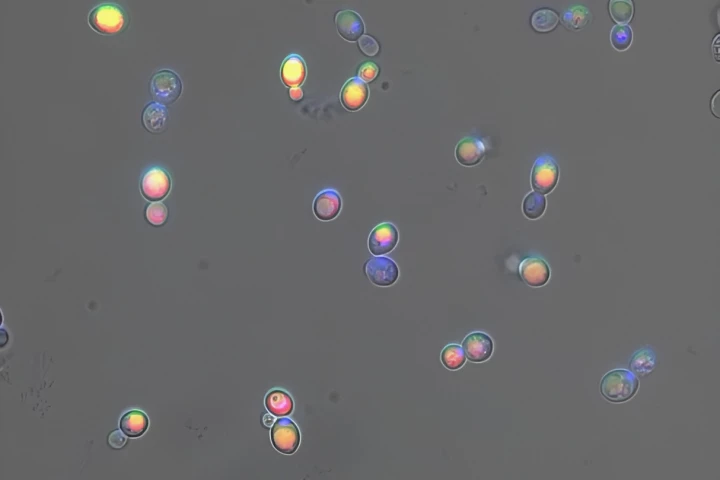 There may be a new use for that urine you've been so thoughtlessly flushing. Scientists say it could be an alternate source of a valuable bone- and tooth-repair material, with a little help from a genetically modified type of yeast.
 -
 Under the right circumstances, electrons can actually “freeze” into a bizarre solid form. Now, physicists at Berkeley Lab have created and taken the first ever direct images of this structure.
 -
 Scientists at Berkeley Lab have used a titanium beam to make atoms of element 116. This new way to make the super rare element stands as a proof-of-concept that they could soon potentially create the undiscovered element 120, which may be stable.
 -
 Scientists have discovered that a once-in-a-billion-years evolutionary event is underway, as two lifeforms have merged into one organism that boasts abilities its peers would envy. Last time this happened, Earth got plants.
 -
 Climate change will trigger stronger storms more often, and the threat may not be properly communicated. Now, scientists at Berkeley Lab suggest there’s room for a Category 6 on the scale – with five storms in the past decade reaching that strength.
 -
 It takes tons of plant matter to make each gram of the cancer drug vinblastine. To find an alternative source, scientists have engineered yeast to produce the precursors of vinblastine, which could help make this vital drug more available and affordable.
 -
 Data from DESI's first survey run has produced the largest and most detailed 3D map of the universe so far. The stunning image reveals the gigantic cosmic web of galaxies across billions of light-years – and the project is only just beginning.
 -
 Bacteria have developed crafty weapons in their ongoing wars, such as tailocins, which act somewhat like “homing missiles” against their enemies. Now, researchers have investigated just how tailocins work, and how we might use them to our advantage.
 -
 The Linac Coherent Light Source (LCLS) is an extremely powerful X-ray laser – and now it's about to get even more powerful. The second generation of the instrument has now achieved first light, with scientists demonstrating fine control of the beam.
 -
 Scientists at Berkeley Lab have developed a sort of “solar umbrella” which could radically reduce the amount of land needed for industrial evaporation ponds.
 -
 A promising new cancer drug will soon enter phase 2 clinical trials, after finding success in animal models and preliminary human studies. Known as AMG 510, the drug targets a gene mutation that’s one of the most common causes of cancer.
Load More