
Lab on a Chip
-
 UCLA researchers have developed a tiny sensor to monitor metabolites – substances produced or used when your body breaks down food or medication – far more extensively than current methods. It could unlock better disease diagnosis and drug development.
 -
 When conducting cardiac research, it would be ideal if experiments could be performed on actual living human hearts. Scientists have developed what may be the next-best thing, in the form of a tiny mechanical heart powered by real cardiac cells.
 -
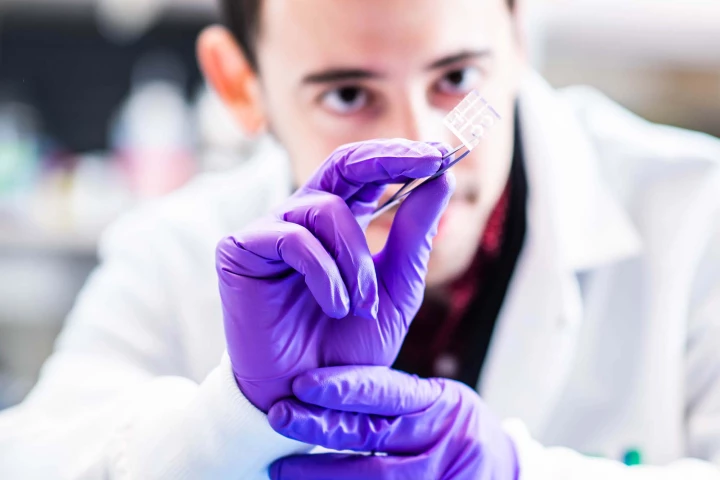
 A new breakthrough could help unravel the immune system's secrets. Researchers have created an accurate model of the human immune system in a microfluidic chip, providing a better platform to study how immune cells respond to vaccines and pathogens.
 -
 While scientists have successfully produced various "organ-on-a-chip" models of body parts, the eye is particularly challenging, as a tear film is regularly moved across its surface as we blink. That action has recently been replicated, in a new device.
 -
 One consequence of cancer and other diseases spreading throughout the body can be the hardening of the extracellular matrix surrounding cells. Scientists have now developed a new way to non-destructively detect such changes using sound waves.
 -
 Scientists have pieced together 10 devices that mimic the functions of different organs to create a functioning Body-on-Chips platform, which can offer new and comprehensive insights into how prospective drugs will behave throughout the human body.
 -
 We're seeing an increasing number of organ-on-a-chip devices, in which small pieces of living biological tissue are used to replicate the functions of actual organs. Now, scientists have created a tooth-on-a-chip, which mimics a tooth with a cavity.
 -
 With little more than a standard inkjet printer, some silicone, and a sheet of polymer film, Stanford researchers have created a reusable diagnostic "lab on a chip" that costs just 1 cent to make. This new technology could help vastly improve disease detection worldwide.
 -
 Organs-on-chips allow the study of drugs and diseases without testing on animals or humans. Now a team at Harvard has designed a device that smokes cigarettes and sends the smoke through a lung-on-a-chip, to examine just how the habit damages health.
 -
 The organ-on-a-chip concept has been around for a while now, providing researchers with working, lab-based models of hearts, kidneys, and more. Now, researchers have created a new placenta-on-a-chip, a device that could provide insights to help prevent preterm births.
 -
 The Hoope ring is worn on the thumb, and can reportedly diagnose diseases such as syphilis, gonorrhoea, chlamydia and trichomoniasis in less than a minute. It could also be adapted to detect other conditions.
 -
 The latest advance in the area of smartphone diagnostics comes in the form of a fiber optic sensor that when attached to a phone's case, could monitor bodily fluids to test for things such as pregnancy or keeps tabs on diabetes.
Load More