
Glass
-
 A new study analyzed beverages like water, soda, wine, and beer to find out how many microplastic particles were in each. The results were a surprise, with a container commonly thought to be safe actually found to carry the highest volume of particles.
 -
 Crop fertilizers are a major source of pollution, as the chemicals make their way out of the soil and into the environment. Scientists are now working on a solution to that problem, by developing a fertilizer that takes the form of tiny glass beads.
 -
 Even if you don't know what 3D microfluidic networks are, that doesn't change the fact that they have some very valuable possible uses. Scientists have now devised a much easier method of making the things, by taking casts of plant roots.
 -
 How do you keep a glass of beer cold the longest? With science, of course. That's what one researcher has turned to, finding the optimal shape of drinking vessel that will keep a poured beer chilled for as long as possible while you drink it.
 -
 Scientists have demonstrated a new potential treatment for bone cancer. A bioactive glass laced with a toxic metal was able to kill up to 99% of the cancer without harming healthy cells, and could even help regrow healthy bone after.
 -
 Glass-fragment waste typically just ends up in landfills, but perhaps that doesn't always have to be the case. A study shows that ground glass particles can be mixed with soil to produce a plant growth medium that's actually better than soil alone.
 -
 Collectors of trading cards are always hunting for rare shiny variants – and now astronomers have found the exoplanet equivalent. The shiniest planet ever found, LTT9779 b, is an ultra-hot, cosmic disco ball thanks to clouds made of glass and titanium.
 -
 Robots and other automated systems have always had trouble visually gauging the 3D shape of transparent objects, like those made of glass. A new system addresses that problem, by using a laser to quickly heat such items.
 -
 The number of healthcare-associated urinary tract infections could soon drop dramatically, thanks to the use of special antimicrobial glass.
 -
 Although glass is thought of as being eco-friendly because it's recyclable, the fact is that a lot of it doesn't get recycled. Now, however, scientists are suggesting that glass waste could be used to make concrete that's stronger and cheaper.
 -
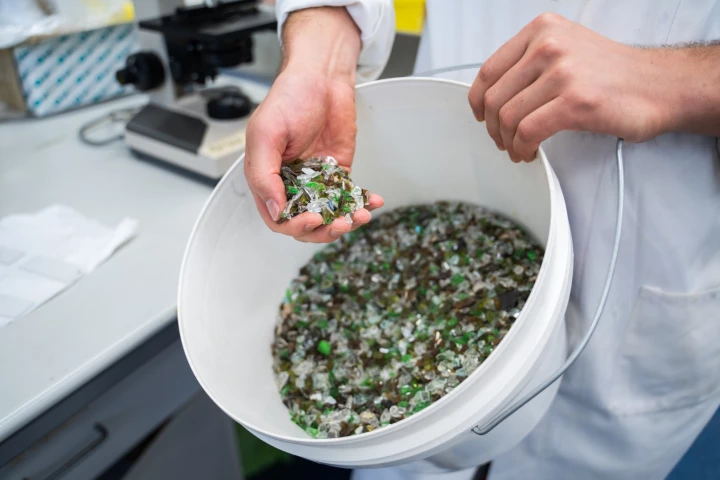 Although glass IS recyclable, the recycling process is generally limited to large pieces that can be easily sorted by color. Because it's not worth the effort to sort smaller fragments, they tend to simply be discarded. A new process, however, can convert them into a useful substance.
 -
 PNNL has vitrified low-level radioactive waste taken from a tank at the decommissioned Hanford Site nuclear production complex in Washington state for the first time in a continuous process. The waste was turned into durable glass that immobilizes the radioactive and chemical compounds inside.
Load More