
Flares
-
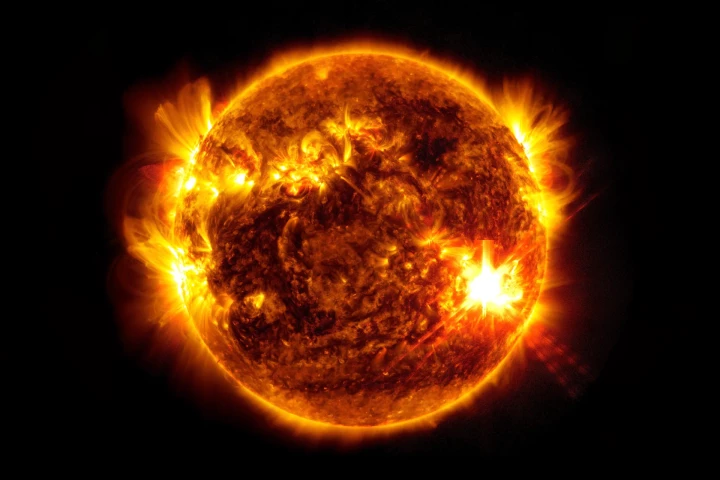 While millions of people who couldn't normally see the aurora took in the recent color-filled spectacle in the night sky, NASA's Solar Dynamics Observatory was looking straight at the sun to catch the action. The fiery footage is well worth a watch.
 -
 Our Sun is capable of terrifying outbursts – and now scientists have discovered evidence of its biggest tantrum on record. Tree rings dating back 14,000 years contain a radiocarbon spike twice as powerful as the previous biggest known solar storm.
 -
 Solar wind – charged particles from the Sun – pervades our solar system, but the exact mechanism behind it remains murky. Now ESA’s Solar Orbiter spacecraft has observed previously unknown tiny flares on the Sun’s surface spewing plasma into space.
 -
 Tree rings can preserve a snapshot of the Earth throughout the tree's life. Now Australian scientists analyzing these records have found evidence of huge radiation storms that periodically bathe the planet – and their origin remains a mystery.
 -
 Contrary to their name, black holes are known to fire off flares from time to time, but exactly how this happens is shrouded in mystery. High-resolution simulations have now revealed how twisting magnetic fields can throw off huge amounts of energy.
 -
 An ESA/NASA spacecraft has captured the closest pictures of the Sun ever taken. The images reveal that our star is covered in relatively tiny flare-like explosions that scientists have dubbed "campfires."
 -
 Astronomers have spotted a tiny, cool star putting on a stellar light show that would shame our Sun. This X-ray “superflare” was 10 times more powerful than anything the Sun can produce, and is completely unexpected for a star this small.
 -
 When it was first discovered in 2016, Proxima b looked like a prime spot to hunt for extraterrestrial life. More recent studies have painted a bleaker picture, and now the final nail in the coffin could be a huge stellar flare detected last year, which would have baked the surface of the planet.