
Explosives
-
 While bomb-sniffing dogs provide an invaluable service, training them using actual explosives can be risky for both the canines and their handlers. A new process could help, utilizing a harmless polymer that quickly absorbs the scent of explosives.
 -
 Cyborg locusts could soon be used to detect explosives. In a new study, locusts were able to smell different amounts of explosive chemicals in the air to track down a bomb, and these detections can be picked up by reading their brain waves.
 -
 It looks as if the days of the venerable explosive TNT are numbered as researchers at the Los Alamos National Laboratory (LANL) and the US Army Research Laboratory in Aberdeen, Maryland develop a new explosive that has the power of TNT, yet is safer and more environmentally friendly.
 -
 The strength of spinach isn't only in its nutrients, but also in its ability to be hacked to function as a sensor able to detect things like explosives, according to researchers at the Massachusetts Institute of Technology.
 -
 Suicide bombers are a tactic that is effectively deployed all too often. One entrepreneur is looking to help reveal such threats with a detector that scans subjects for shrapnel commonly used in suicide vests and explosives.
 -
 A team of researchers at the University of Utah has integrated carbon nanotubes into a prototype explosives sensor. It can also detect illegal drugs and toxic chemicals such as nerve gas, reportedly doing so better than currently-used technologies.
 -
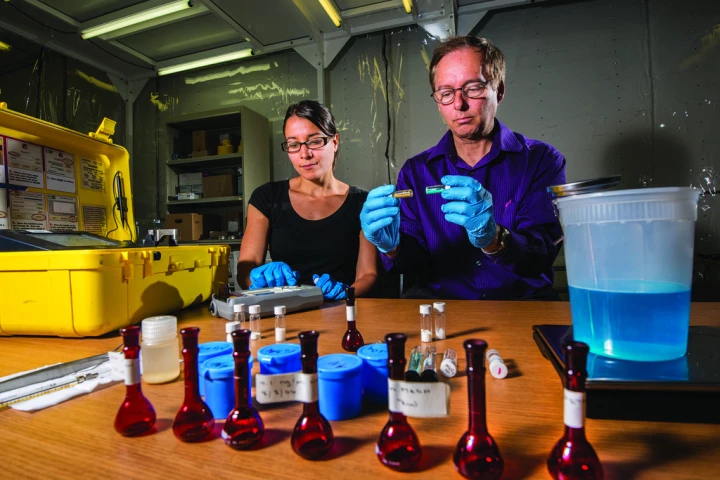 Kevin Fleming, an optical engineer at Sandia National Laboratories, has developed a fertilizer alternative to ammonium nitrate that isn’t detonable so can’t be used in a bomb.
 -
 A team of UCSB researchers have mimicked the anatomy of a dog's nose to build a highly effective scent detector that could be used to sniff out explosives and narcotics.
 -
 A consumer laser pointer has been used to create a small, inexpensive Raman spectrometer.
 -
 Engineers at the University of Connecticut (UConn) have developed a fluorescent nanofibrous film capable of detecting ultra-trace levels of explosive vapors from landmines and other buried explosive devices.
 -
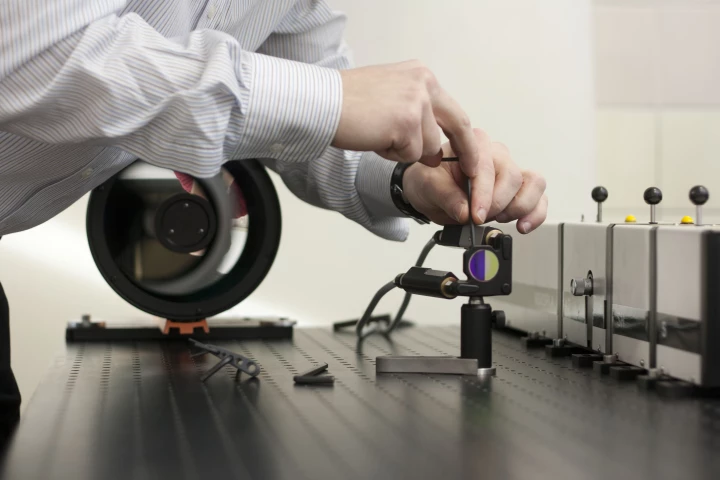 Researchers at the Vienna University of Technology have developed a system that uses laser beams to allow explosives within a nontransparent container to be detected at distances of over 100 meters.
 -
 Foam made from graphene has been shown to be ten times more effective than traditional polymer sensors, when it comes to detecting gases associated with explosives.
Load More