
Entanglement
-
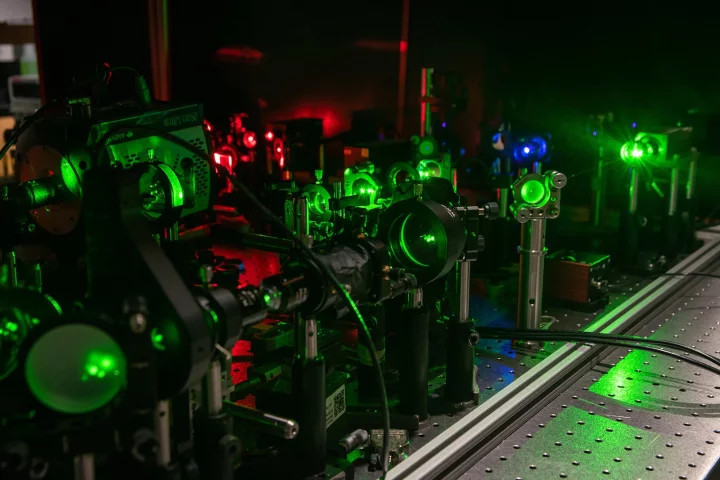 Caltech scientists have created a quantum microscope that taps into the quirky quantum rules to see tiny details much more clearly. Using pairs of entangled photons allows the instrument to double the resolution of images without damaging the sample.
 -
 Physicists at Brookhaven National Laboratory have discovered a completely new type of quantum entanglement, the spooky phenomenon that binds particles across any distance. This allowed scientists to peer inside nuclei in more detail than ever before.
 -
 The 2022 Nobel Prize in Physics has been awarded to three scientists, Alain Aspect, John F. Clauser and Anton Zeilinger, who all conducted some of the first experiments with entangled photons, enabling a future for commercial quantum computers.
 -
 Scientists have developed a way to produce a web of quantum entangled photons using a far more simple setup than usual. The key is a precisely patterned surface 100 times thinner than paper, which could replace a roomful of optical equipment.
 -
 University of Oxford physicists have linked two atomic clocks through quantum entanglement for the first time. The feat can help make these clocks so precise that they begin to approach the fundamental limit of precision set by quantum mechanics.
 -
 Physicists at the Max Planck Institute have developed an efficient new method to drive the quantum entanglement of photons, and demonstrated it by entangling a record number of photons. The technique could be a boon for quantum computers.
 -
 Quantum computers could one day outperform traditional machines, but hurdles remain. Now physicists have successfully entangled three silicon quantum dots for the first time, in a breakthrough that could help make quantum computers more practical.
 -
 Atomic clocks are our most precise timekeepers, with the best ones keeping time to within one second in 15 billion years. But there’s always room for improvement, as researchers at MIT have now demonstrated with a new quantum-entangled atomic clock.
 -
 Engineers at Brookhaven National Laboratory have designed a strange new X-ray microscope that takes advantage of the spooky world of quantum physics to “ghost image” biomolecules in high resolution but at a lower radiation dose.
 -
 In quantum entanglement, particle links are thought to be fragile. But now, physicists have managed to produce hot clouds of trillions of entangled atoms, breaking quantity records and showing that entanglement isn’t as fragile as previously thought.
 -
 Physicists have harnessed the weird world of quantum physics to develop a “quantum radar” prototype. The system uses the quantum entanglement phenomenon to detect objects, and it could eventually outperform conventional radar in some circumstances.
 -
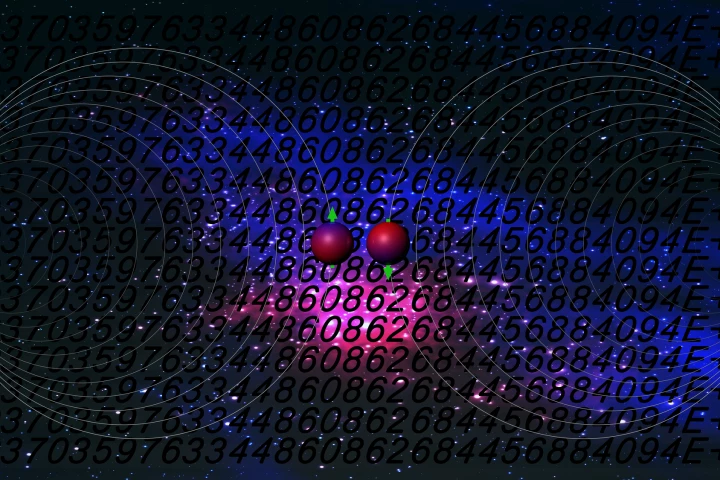 Scientists have achieved quantum teleportation between two computer chips for the first time, sending information between them without being physically or electronically connected. The feat opens the door for quantum computers and quantum internet.
Load More