
Color
-
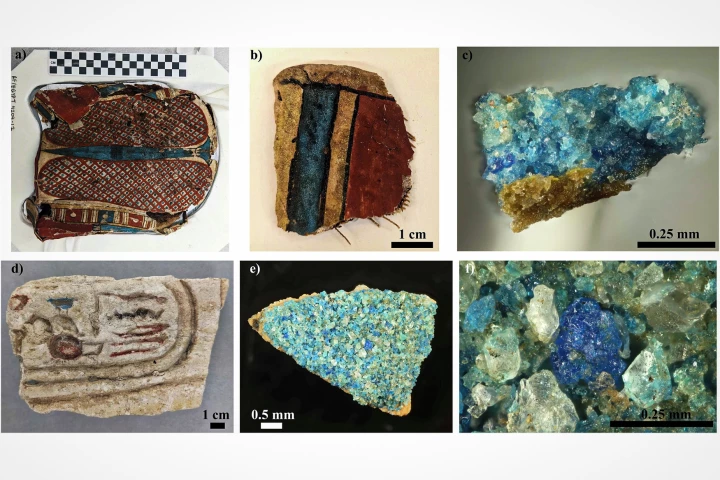 Ancient Egyptians were not only masters of architecture but also wizards of chemistry. Around 5,000 years ago, they crafted the world’s first synthetic pigment, Egyptian blue, and now researchers think they've finally figured out the original recipe.
 -
 Speaking a language with different words for different color shades means the brain perceives those shades quicker than using a language with only one word for that color, highlighting the interaction between language and perception according to a new study.
 -
 An amphibian has lived up to its name, swapping out its usual green coloring for bright blue, in the first-ever record of a magnificent tree frog with this appearance. It's stunned scientists, who know they're unlikely to see this again.
 -
 The Disney-esque hues on bluespotted ribbontail rays come from a unique arrangement of nanostructures, say researchers. The findings, along with those gleaned from studying blue sharks, could help lead to new chemical-free color techniques.
 -
 Scientists have had a career-making moment, capturing on film a dolphin with such a rare skin condition that only five other recorded examples exist. The dramatic black-and-white look, or piebaldism, has never been seen on a dolphin in Australian waters.
 -
 Scientists have “painted” with DNA, creating 16 million colors to accurately reproduce digital images with 24-bit color depth. The resulting images are incredible, and represent not just a new art form but potential advances for storing data on DNA.
 -
 If mosquitoes seem to love you but ignore the person sitting next to you, the color of your clothes might be to blame. New experiments reveal that certain colors attract hungry mosquitoes, which could be used to design new traps or repellents.
 -
 Our mental images of the extinct thylacine, or Tasmanian tiger, are tinged in greyscale, since that’s the main way we’re used to seeing them. But now, one of the most famous videos of the animal, shot in 1933, has been professionally colorized in 4K.
 -
 It may seem like a basic color, but blue is actually rather rare in the natural world. That complicates the search for natural blue food colorings, but now a team of scientists has found a promising candidate hiding in red cabbage.
 -
 Yale researchers have found evidence that worms can detect the color blue – even though it doesn’t have eyes or any kind of visual system. In tests, the team found that the color of harmful bacteria influenced whether or not the worms avoided them.
 -
 Researchers from the Chinese Academy of Sciences have developed a smart bandage that changes color to signal either drug-resistant or drug-sensitive bacteria. It can then be triggered to release antibiotics or other chemicals to kill off the bugs.
 -
 Thousands of years ago, the ancient Egyptians created a blue pigment which they used in their depictions of gods and royalty. Derived from calcium copper silicate, the substance is now known as Egyptian blue – and it could be used to both save power and generate electricity.
Load More