
cellulose
-
 Instead of growing, harvesting, processing, and shipping fabric across the world, why not let non-polluting bacteria grow it and dye it in a single container? Korean scientists are taking the first steps towards doing that very thing.
 -
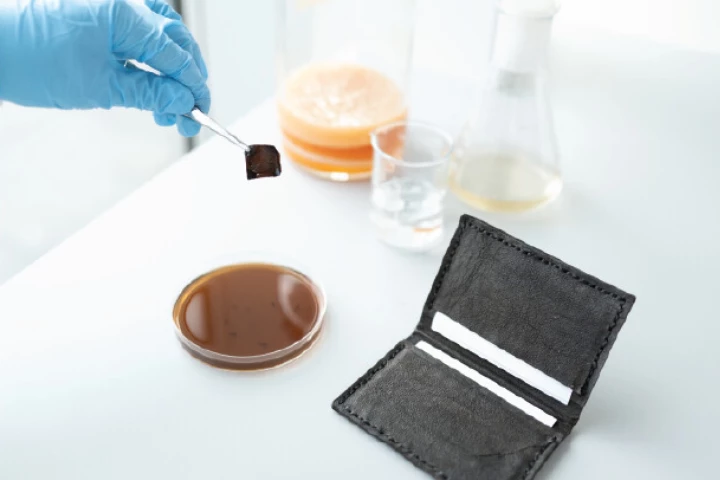 Bacteria-produced leather is already an eco-friendly alternative to its cow-derived counterpart, but it could soon be even eco-friendlier. Scientists have gotten the microbes to color the stuff themselves, eliminating the need for toxic dyes.
 -
 So-called "bonded leather" is really just leather fibers mixed with eco-unfriendly polyurethane or PVC. reProLeather, on the other hand, converts leather waste into what is claimed to be a recyclable, biodegradable, new-leather-like material.
 -
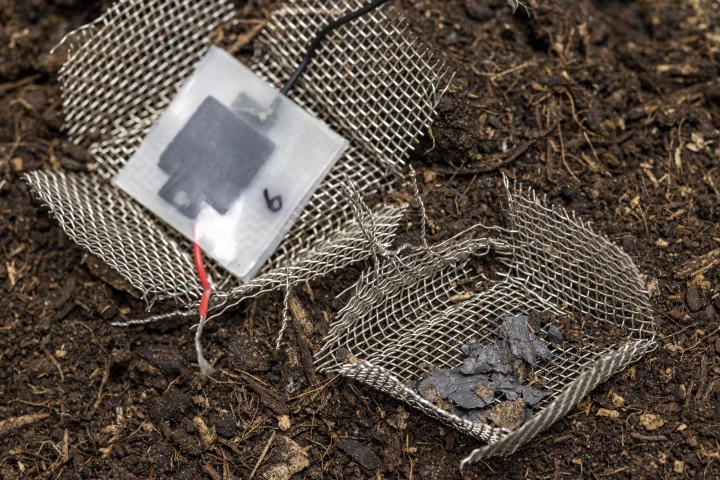 As technology continues to evolve, we're going to see an increasing number of battery-powered connected devices – some of which will be single-use, like shipping packaging. A new biodegradable mini-capacitor has been created with such uses in mind.
 -
 Although not a huge seller everywhere, durian fruit is consumed in great quantities in countries like Singapore. Scientists there have now developed a method of using its husks to create cheap, eco-friendly, antibacterial hydrogel bandages.
 -
 Many "cold chain" items such as food or medicine are shipped in single-use expanded polystyrene foam (EPS) packaging, which is difficult to recycle and non-biodegradable. Such is not the case with a new material, however, made from discarded paper.
 -
 Although it's vitally important to keep wounds free of harmful bacteria, antibacterial ointments have to be regularly reapplied, requiring bandages to be removed. A new wound dressing, however, is claimed to continuously kill bacteria all on its own.
 -
 While no one likes seeing plastic waste floating in our waterways, tiny "microplastic" particles are also a threat to the aquatic environment – and to human health. A study now suggests that nanocellulose could be used to remove them from the water.
 -
 We've been hearing more and more about biodegradable plastics, made from cellulose nanofibers. Although those fibers are typically harvested from wood waste, new research shows that they could also be obtained from mega-plentiful used coffee grounds.
 -
 It's an unfortunate fact that pacemakers do need to be surgically replaced every five years or so, before their battery runs out. The procedure could soon be considerably easier and safer, though, thanks to a membrane that goes around the implant.
 -
 Cellulose and chitin are the world's first- and second-most common biopolymers, found in plants and crustacean shells (among other places) respectively. Georgia Tech scientists have now devised a method of combining the two, to produce plastic-like compostable food wrap.
 -
 When it comes to clothing, being both environmentally-conscious and fashionable can be tricky. Old clothes can be given away, of course, but they still ultimately end up in the landfill. That's why scientists have devised a method of essentially "melting down" old clothes to make new material.
Load More