
Carnegie Institution for Science
-
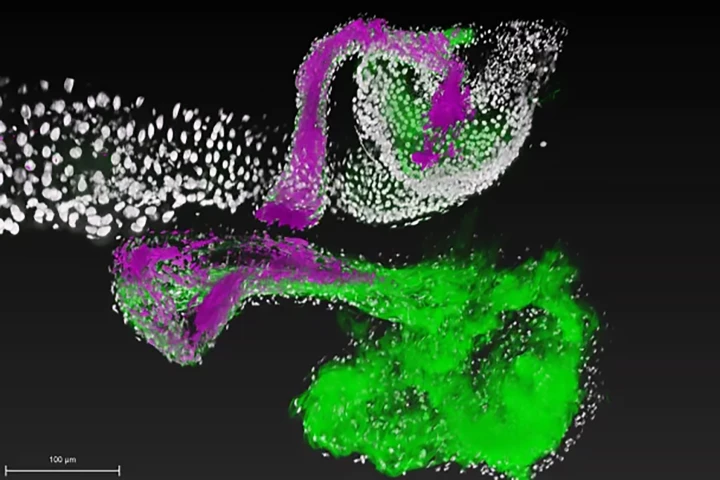 Beneficial bacteria occupy specific regions in the gut, contributing to our health via the microbiome. A new study has identified the genes that good bacteria use to colonize these regions, opening the door to creating engineered probiotics.
 -
 A new study led on how water could form on young exoplanets with hydrogen atmospheres and molten oceans of magma suggests that Earth-like planets may not be as rare as once thought and that the presence of water on such planets may be almost inevitable.
 -
 The extremely hot interior of Earth is slowly cooling down, but exactly how fast is unknown. By studying how well a common deep-Earth mineral conducts heat, researchers have now found that the planet’s interior may be cooling faster than expected.
 -
 An international team of researchers has made a discovery that could prove useful to the efforts to preserve the world's coral reefs, using the CRISPR/Cas9 gene editing tool to identify a key gene that regulates their response to heat stress.
 -
 Aquatic hypoxia can be a serious problem, producing oxygen-depleted "dead zones" in lakes or seas. New research suggests that a process known as downwelling may help keep those zones from forming – although it wouldn't be a cheap solution.
 -
 The discovery of 20 new moons around Saturn brings its total to 82 – three more than Jupiter, which was previously thought to hold the record.
 -
 Astronomers are welcoming the newest and most distant object in the solar system – a dwarf planet orbiting more than 100 times further from the Sun than Earth. And because its discoverers aren’t the most creative bunch, it’s been dubbed “Farout.”
 -
 There could be thousands of dwarf planets – Pluto-sized or smaller – lurking at the very edges of the Sun’s influence. Now, astronomers have spotted a new distant dwarf with an incredibly wide orbit, lending further evidence to the idea that a much bigger “Planet X” is out there somewhere.
 -
 With dozens of moons whizzing around Jupiter, it makes sense that a few have slipped under the radar, but the latest discovery is still a surprisingly large haul. Astronomers have announced the detection of 12 new moons orbiting Jupiter, including one particularly reckless “oddball.”
 -
 When it was first discovered in 2016, Proxima b looked like a prime spot to hunt for extraterrestrial life. More recent studies have painted a bleaker picture, and now the final nail in the coffin could be a huge stellar flare detected last year, which would have baked the surface of the planet.
 -
 When you're dealing with astronomical bodies that are light years away from you, sometimes classifications can be tricky. That seems to be the case with SIMP0136, an object located in a 200-million-year-old group of stars called Carina-Near.
 -
 If you grew up knowing that there were nine planets orbiting our sun and were a bit crushed when Pluto lost its status, there might be new hope for a nine-pack, as researchers are again putting forth the idea that a planet might be lurking somewhere out there on the fringes of our Solar System.
Load More