
Venus
-
 A potentially destructive Soviet Venus lander that was lost in space for over half a century has reentered the Earth's atmosphere. Tracked by various space agencies and individuals, the capsule crashed on May 10 somewhere in the Indian Ocean.
 -
 The Space Age past may come knocking on the world's door next week as the defunct Soviet Union's Kosmos 482 Venus lander from 1972 makes an unwelcome return home and is predicted to crash into the Earth's atmosphere around May 10.
 -
 Venus may be a hellscape, but there’s a chance some forms of life could evolve there. A new MIT study has now found that the building blocks of life are surprisingly stable in highly concentrated sulfuric acid – which Venus’ clouds are made of.
 -
 Is the evolution of our nearest planetary neighbor into a nightmarish hellscape typical? If it is, should Earthlings be worried? To find out, astronomers have proposed using the James Webb Space Telescope to look at five exoplanets in the Venus Zone.
 -
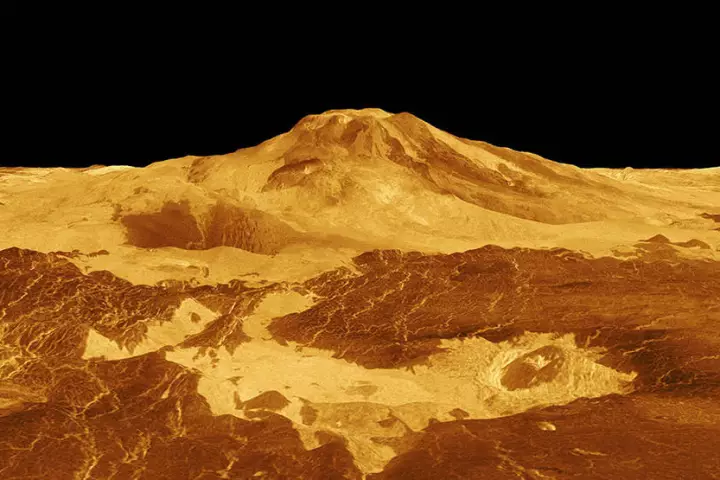 After decades of speculation, astronomers have discovered the first direct evidence of volcanic activity on Venus. Radar images of Earth’s “twin” taken just a few months apart reveal a recent eruption.
 -
 Though designed to study the Sun, NASA's Parker Solar Probe has scored a first by collecting the first images of the surface of Venus in visible light using its Wide-Field Imager (WISPR) while flying by the planet's night side in 2020 and 2021.
 -
 The endless expanse of space is a beautiful and fascinating subject for photography. From the dramatic births and deaths of stars, to galactic glamor shots and planetary close-ups, here are some of the most breathtaking space photos of 2021.
 -
 Is there microbial life floating around in the clouds of Venus? Scientists have long pondered this question and soon we may get some answers, starting with a cloud-skimming mission in 2023 to search for signs of life.
 -
 New modeling of water activity on different solar system planets has found that Venus would be too dry for even the most extreme forms of life – but there may be other contenders in our solar system that we hadn’t considered.
 -
 Venus should have been Earth’s twin, but clearly that’s not the case today with its thick poisonous atmosphere and barren rocky surface. Now, as part of its Discovery Program, NASA has selected two new missions to Venus to investigate what went wrong.
 -
In September 2020, astronomers announced the discovery of phosphine in the atmosphere of Venus, a possible sign of life. But a new study has found that a different gas could explain the signature – one that's more common and doesn’t indicate life.
-
 Venus may owe its extreme atmosphere to an ancient run-in with the gas giant Jupiter, which could have fundamentally altered the planet’s orbit, and led to the loss of massive amounts of its water reserves.
Load More