
University of Western Australia
-
 A large study has found that calcium supplements, long recommended for bone health, particularly in older women, don’t increase dementia risk, offering reassurance for the millions who take them to protect against osteoporosis.
 -
 In the first study of its kind, excess abdominal fat has been associated with chronic pain, but the good news is that losing weight that can reduce waistlines could help relieve widespread musculoskeletal conditions and greatly improve quality of life.
 -
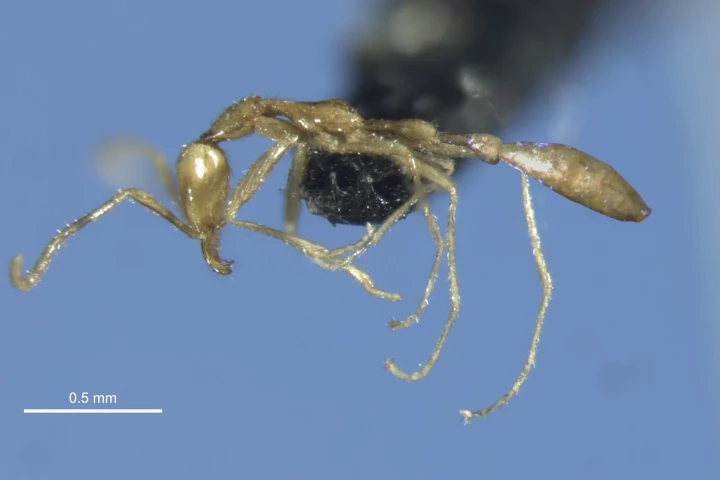 A new ant has been named after the creepiest of all Harry Potter villains, Lord Voldemort. Like the lord, the ant is pale, slender and lives in the dark – unlike Mr. Voldemort, however, the ant did not give Harry his lightning-bolt forehead scar.
 -
 A new study has found that exposing babies to prescription opioids while they’re in the womb can increase their risk of developing immune-related conditions – particularly infections, eczema and asthma – in early childhood.
 -
 Researchers have discovered the largest plant in the world – a meadow of seagrass off the coast of Western Australia that covers a total of 200 sq km (77 sq miles). The entire expanse has grown from just one seedling, spreading by cloning itself.
 -
 The mosquitofish is a harmful invasive species in much of the world, outcompeting and overwhelming native fish and other aquatic life. Scientists are now working on a solution to the problem, in the form of a robotic bass.
 -
 A new type of gravitational wave detector has recorded two rare events that may be signals of dark matter or primordial black holes. These high-frequency gravitational waves are beyond the range of most detectors and have never been recorded before.
 -
 Results from the world's first placebo-controlled clinical trial testing the efficacy of medicinal cannabis for chronic insomnia reveal statistically significant, and dose responsive, improvements to sleep quality using a novel CBD/THC formulation.
 -
 Scientists from Australia’s CSIRO have now found a fungus species that mines for gold and even decorates itself with the precious particles. Following the fungus could be a new, environmentally-friendly way to find large underground gold deposits.
 -
 Irritable bowel syndrome (IBS) is a common condition that causes bloating, diarrhea and constipation. It's also difficult to diagnose – often a colonoscopy is required in order to do so. Soon, however, it may be possible for doctors to simply use a belt that listens to patients' guts.
 -
 Our universe seems to contain a suspiciously perfect amount of "dark energy" to sustain life. But new research suggests that life is still possible even with far more dark energy than we have, and the results have some big implications for the multiverse theory.
 -
 Research from the University of Western Australia has shown that plants can learn by association, like Pavlov's dogs. The scientists conditioned seedlings to associate light with the wind from a fan, and found that the plants learned to use the fan to predict where light would next appear.