
University of Tokyo
-
 Blood sampling is painful, plus it only tells you what's going on in the patient's body right when the sample is taken. So, how about this? Permanent skin grafts that glow green when specific biomarker chemicals are present in the bloodstream.
 -
 While scientists are amassing a fair amount of data regarding our gut microbiomes, the oral microbiome is a bit of a new frontier. Case in point: researchers have just discovered huge pieces of DNA there that they never knew existed.
 -
 Scientists in Japan have created hybrid plant-animal cells, essentially making animal cells that can gain energy from sunlight like plants. The breakthrough could have major benefits for growing organs and tissues for transplant, or lab-grown meat.
 -
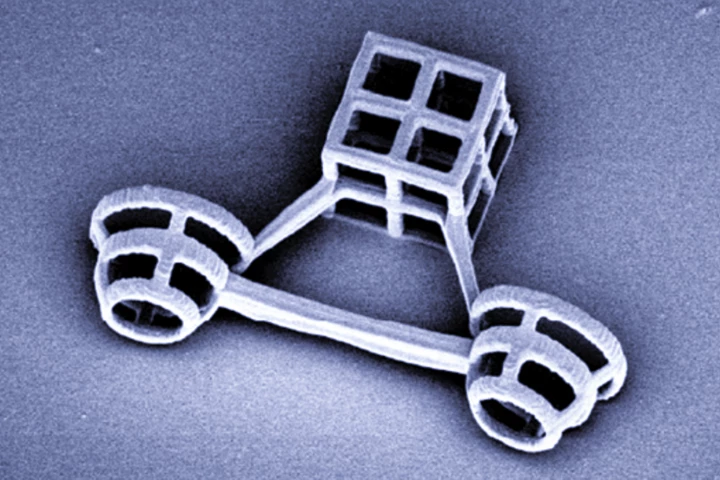 From dog sleds to horse-drawn carts, animals have been pulling vehicles for thousands of years. Now, scientists in Tokyo have made what might be the smallest version ever, designing microscopic vehicles that can be pulled by single-celled algae.
 -
 When it comes to protecting crops via insect-blocking netting, you may think that the size of the holes in that netting is the most important factor. According to new research, however, the color of red netting makes an even bigger difference.
 -
 CBT is a multifaceted approach recommended as a treatment for chronic insomnia. A new study looked at CBT components to determine which are most effective for improving sleep, finding that relaxation techniques may potentially be counterproductive.
 -
 While it's important for your dog or cat to have a form of ID in case they get lost, tags can fall off, and microchips can migrate out of place. Japanese scientists are developing an alternative, in the form of quick and painless tattoos.
 -
 Earth has been blasted by the second strongest ultrahigh-energy cosmic ray ever observed. While its origins remain unknown, astrophysicists are pointing the finger at the Local Void, a fundamentally empty area of the cosmos next to the Milky Way.
 -
 What has eyes, antennae, swimming bristles, a genes stash and a feel for autonomy? The rear end of the bizarre Japanese green syllid worm. Scientists now know how the end of the animal detaches and swims off to find a similar tail of the opposite sex.
 -
 Cosmic radio signals are beaming to Earth every day – and astronomers are stumped as to their origin. Now a new study finds evidence that these signals, known as fast radio bursts (FRBs), could be caused by “starquakes.”
 -
 Unlike the stuff underneath your TV cabinet, interstellar dust plays a major part in the total luminosity of the galaxy. Scientists have used long-term observational data to see how interstellar dust correlates with a star’s brightness.
 -
 Microalgae are widely used in products such as biofuels, nutritional supplements and cosmetics. A newly-described type has been found in a home aquarium – and it could prove to be particularly useful.
Load More