
University of Oregon
-
 In a new study from the University of Oregon, scientists turned up the temperature to see which type of passive heat therapy packs the most health punch – hot baths, traditional saunas, or those fancy far-infrared saunas.
 -
 A strange sea creature known as the salp reproduces asexually, building long chains of clones. Researchers have now decoded the way these long salp chains propel themselves, a finding that could lead to better propulsion systems for underwater vehicles.
 -
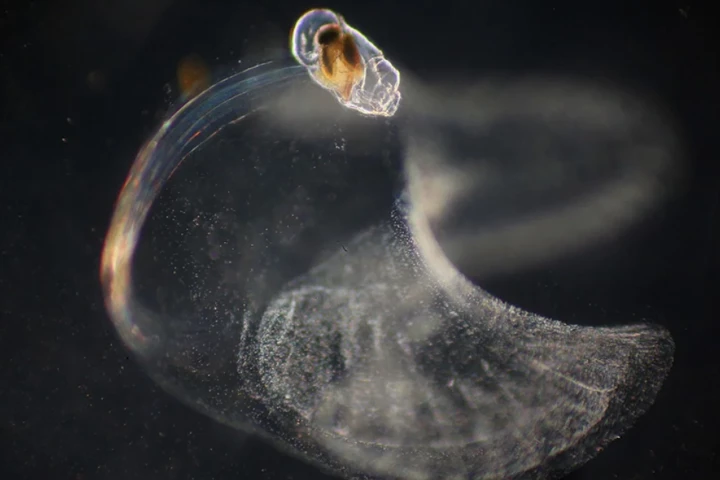 A house made of mucus may not sound like a desirable abode, yet researchers have found that the crafty animal creating such an unappealing structure may help engineers design cheaper and more efficient pumps for industrial uses like water filtration.
 -
 Researchers got tiny worms high on cannabis to see how it affected their food preferences and found striking similarities between them and us. The discovery could lead to the development of targeted drug therapies.
 -
 Why do ants and other small creatures have such sharp bites? According to scientists from the University of Oregon and the Pacific Northwest National Laboratory (PNNL), the answer lies in their ability to uniformly add zinc atoms to their teeth.
 -
 The universe likes to play coy about its age, but we have a pretty good idea of the range. Now, a series of new studies has investigated the question using different methods, and have reached different answers, separated by more than a billion years.
 -
 A team of scientists has created a mathematical model for what they say is the ideal coffee, recommending that a less-is-more approach could lead baristas to produce one heavenly espresso after another, using around a quarter fewer beans.
 -
 Devices such as digital cameras electronically measure levels of high-energy light, and that's good enough for most of us. Now, however, scientists have developed a mechanical alternative that works with almost all types of light.
 -
 You might think that with today's composite dental fillings, once you get a tooth filled, it's good for life. According to Prof. Jamie Kruzic, however, "almost all fillings will eventually fail." That's why he's part of a team that's looking into a longer-lasting filling material: bioactive glass.
 -
 A team of physicists from the University of Oregon (UO) has calculated that cooling the emissions from coal-fired power plants would result in a reduction of the levels of dangerous chemicals entering the atmosphere, including CO2, by 90 percent.