
University of Central Florida
-
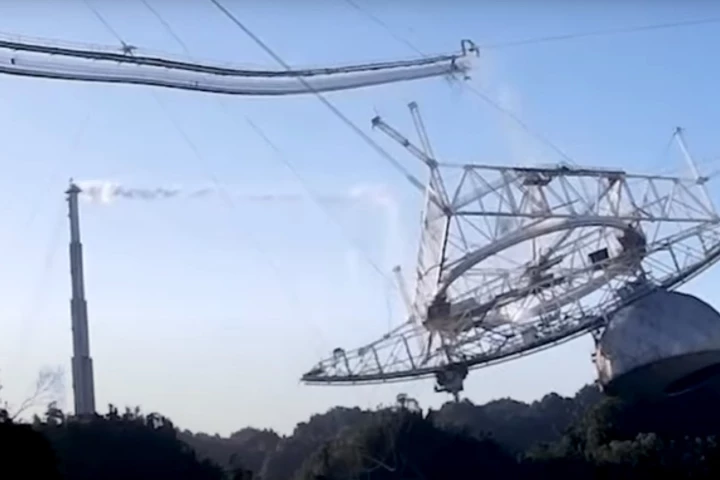 Almost three years after the event, neutron scans by the Oak Ridge National Laboratory have uncovered the cause of the platform collapse that resulted in the destruction of the 1,000-ft (300-m) Arecibo Observatory radio telescope.
 -
 Water on the Moon isn't kept in convenient reservoirs, it’s locked away in the lunar soil. Now, a team of scientists has found that thirsty astronauts could one day refresh themselves fairly easily – by throwing a cup of Moon dirt in the microwave.
 -
 Scientists have created a new class of laser beam that appears to violate long-held laws of light physics. Known as “spacetime wave packets,” these lasers follow different rules of refraction, which could lead to new communication technologies.
 -
 A team of researchers at the University of Central Florida have developed a prototype steam-powered space probe using water as a propellant. The World Is Not Enough spacecraft can operate indefinitely by topping off on ice gathered while visiting asteroids and other bodies to fuel future travels.
 -
 In 1974, astronomers used the Arecibo Observatory to beam a message from humanity to the stars, in one of the most well-known attempts to contact possible alien life. For the 44th anniversary of the Arecibo Message, scientists are reaching out to the public for help in designing an updated version.
 -
 Ancient civilizations could have benefited, and at times suffered from belonging to an interconnected global economy, according to evidence presented in a newly-published study.
 -
 Pluto was demoted from planet status to dwarf planet in 2006. But a new study suggests it should be resurrected as a planet, since the definition the object failed to meet was not based on precedents set in scientific literature.
 -
 If you’ve ever used your phone in sunlight only to see a reflection of your own face, moths might have your back. Inspired by the natural nanostructures that keep the insect’s eyes from being shiny, a team from the University of Central Florida has developed an antireflective film for phone screens.
 -
 Dcientists at the University of Central Florida have come up with synthetic material that draws on visible light from the sun to produce solar fuels, sucking harmful CO2 out of the air in the process.
 -
 To counter blood clots, surgeons administer blood thinning drugs throughout a procedure, but knowing when to do so is difficult. By shining light through the patient’s blood, researchers have developed a new system that gives surgeons real-time feedback and alerts them at the first sign of a clot.