
Underwater
-
 A strange sea creature known as the salp reproduces asexually, building long chains of clones. Researchers have now decoded the way these long salp chains propel themselves, a finding that could lead to better propulsion systems for underwater vehicles.
 -
 Space agencies often put space-suited astronauts in swimming pools, so they can learn to perform tasks in an outer-space-like environment. The UHAB is intended to take things further, by simulating the habitats in which astronauts may someday live.
 -
 Although Saturn's moon Enceladus and Jupiter's moon Europa both have ice-covered surfaces, oceans may exist beneath that ice. The TRIPLE-nanoAUV 2 project is aimed at getting an uncrewed submersible into those oceans, to search for life.
 -
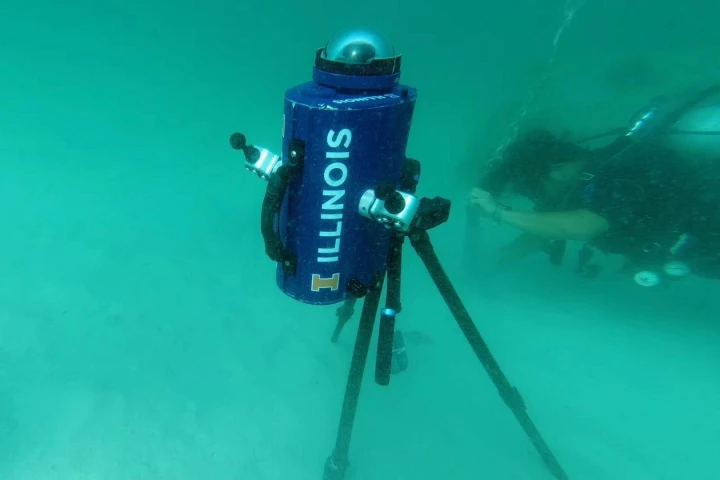 While GPS can be used to determine one's geographical coordinates on land, such is not the case underwater. Scientists have developed an alternative, however, in the form of a system that analyzes the manner in which sunlight is polarized by water.
 -
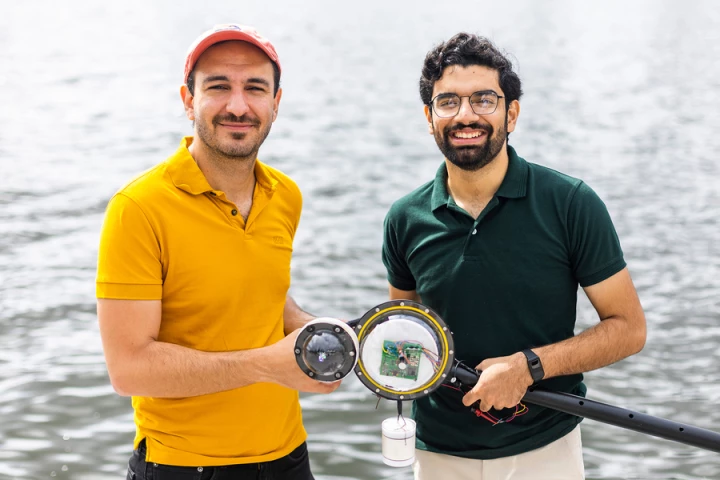 While seabed-located cameras are great for tasks such as monitoring wildlife, powering them can be challenging. That's where a new MIT-designed camera comes in, as it requires no battery, plus it wirelessly transmits its photos through the water.
 -
 Last year, we heard how anole lizards are able to breathe underwater from an air bubble on their nose. One of the scientists involved in that study has now documented a spider doing something similar – although the bubble covers its whole body.
 -
 Radio waves don't travel well through water, which is why devices such as ROVS have to be linked to their operator via a communications cable. According to a new study, however, solar panels may soon allow for practical light-based communications.
 -
 Blue Abyss Ltd. is building the world's largest and deepest indoor pool in Cornwall. Holding as much water as 17 Olympic-sized swimming pools, it will be used for advanced undersea robotics and as the world's first commercial astronaut training facility.
 -
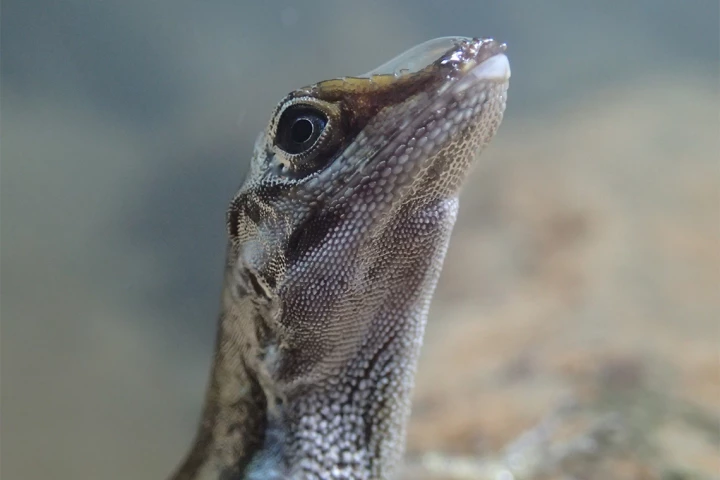 The anole lizard may be a popular pet, but here's something that not many people may know: some of the things can breathe while underwater. A new study has confirmed their ability to do so, and explains what makes it possible.
 -
 MIT scientists have developed an acoustic system that acts like an underwater GPS, yet doesn't need batteries to operate. The system is instead powered by modulated audio signals reflected from the environment to provide net-zero energy positioning info.
 -
 Scientists exploring the Great Barrier Reef have discovered a huge, never-before-seen coral reef, taller than the Empire State Building. Standing detached, the massive structure is the first new reef to be discovered in the area in over 120 years.
 -
 A new study from Cardiff University points to a method that could have helped rescuers narrow down the search zone for Malaysian Airlines Flight MH370 and may make it easier to find future downed craft, along with a host of other violent sea-based events.
Load More