
Telescope
-
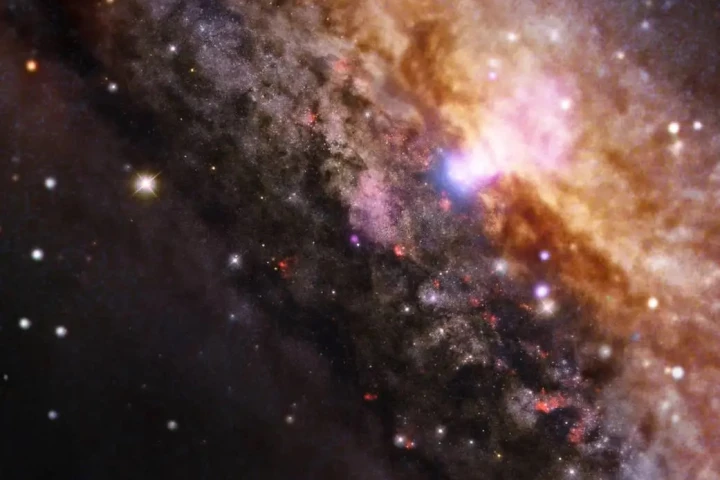 Astronomers have discovered a new celestial object in the galaxy NGS 4945 about 12 million light-years away. Its light is polarized at an almost impossible level that hints at a perfectly aligned magnetic field. The object has been nicknamed "Punctum".
 -
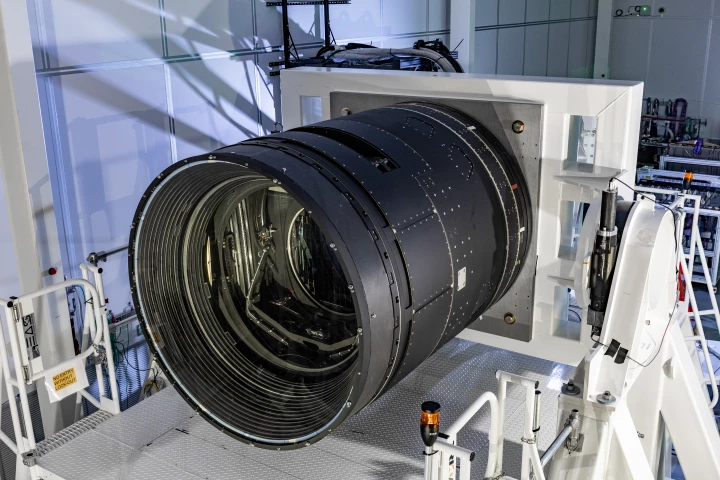 After decades of planning and building, the world's largest digital camera at the heart of the Vera C. Rubin Observatory on the summit of Cerro Pachón in Chile has snapped its first imagery – from test observations spanning a 10-hour window.
 -
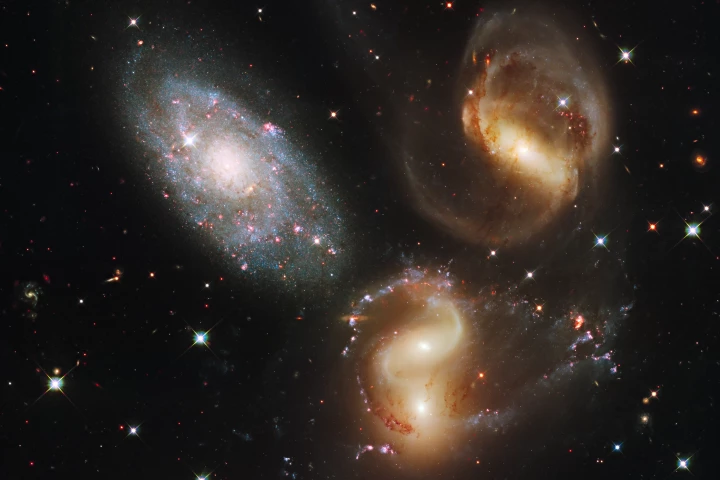 Astronomers have clocked a cosmic collision at 3.2 million km/h (2 million mph). A new instrument has spotted a galaxy crashing through a group of others at incredible speeds, creating a shock wave that’s changing the region completely.
 -
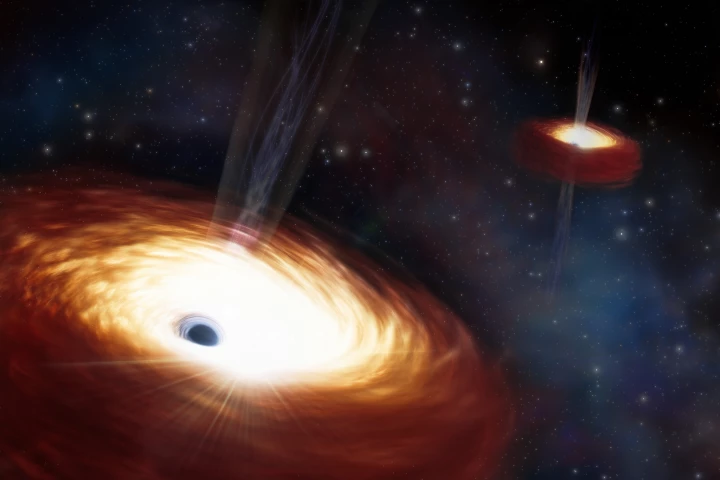 We’ve all regretted taking too long to make a move, but at least it wasn't 3 billion years. That’s how long the sexual tension has been building between two slow-dancing supermassive black holes, whose eventual congress could rock the entire universe.
 -
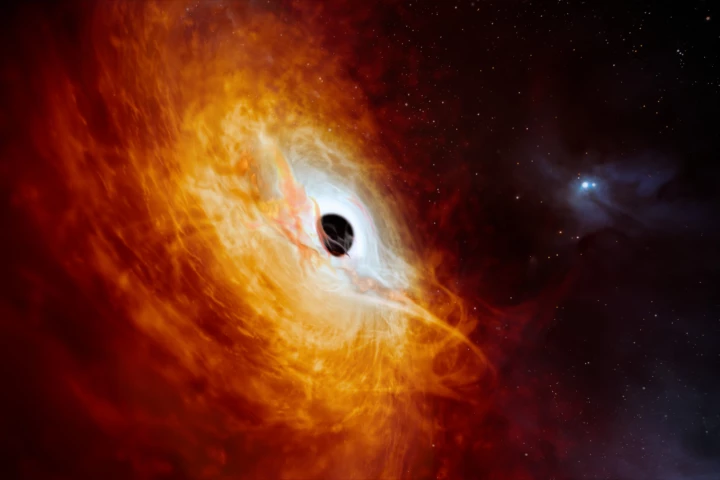 The brightest object in the known universe has just been found. It's a supermassive black hole with the mass of 17 billion Suns, and it swallows another Suns’ worth of material every day, making it also the fastest-growing black hole ever found.
 -
 Astronomers have discovered the most distant – and therefore earliest – known black hole. Hiding in a galaxy called GN-z11, this black hole is bigger than should be possible given the age of the universe.
 -
 You’d never notice one star in the galaxy that wasn’t from around here. Astronomers have now found that a star right near the supermassive black hole at the center of the Milky Way likely originated in a smaller galaxy that ours devoured.
 -
 Earth has been blasted by the second strongest ultrahigh-energy cosmic ray ever observed. While its origins remain unknown, astrophysicists are pointing the finger at the Local Void, a fundamentally empty area of the cosmos next to the Milky Way.
 -
 Decades ago, the astronomy world was taken aback by the discovery of tall light filaments spiking out from around our galaxy's central black hole. Now more filaments have been found, only these have some significant – and puzzling – differences.
 -
 Saturn has overtaken Jupiter as the planet with the most known moons in the solar system. Astronomers have announced a bumper crop of 62 new moons orbiting the ringed planet, pushing its total to well over 100.
 -
 Astronomers are tracking nearby asteroids, but there’s one glaring blindspot in the sky – the Sun. Thankfully, ESA plans to plug the gap soon with NEOMIR, a mission that will give us advance warning of any Earth-bound rocks from that direction.
 -
 Astronomers have released one of the biggest data dumps of the Milky Way ever, cataloging an incredible 3.32 billion cosmic objects in detail. The end result is a gigantic image that can be zoomed in and out for a stunning sense of scale.
Load More