
Spaceflight
-
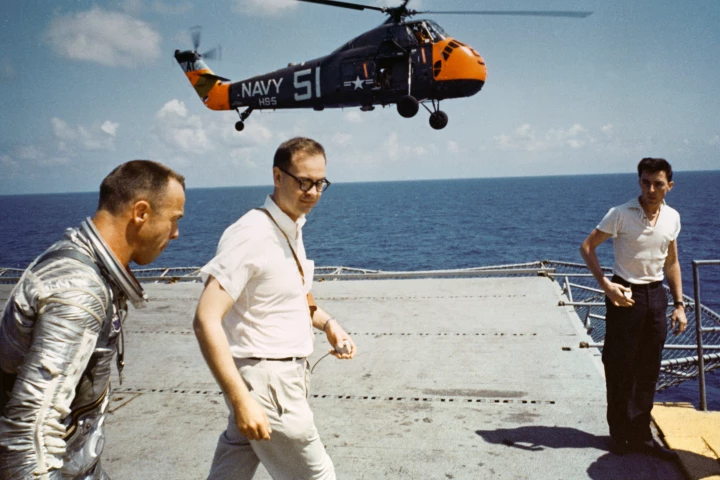 On May 5, 1961, about 45 million US television viewers watched as a single-stage Redstone rocket lifted off from Cape Canaveral. Mercury Redstone 3 carried Alan Shepard on a 15-minute flight to become America's first man in space.
 -
 A recent NASA-funded study has found dormant viruses can reactivate in the human body during spaceflight, presenting yet another physiological problem for scientists to solve before we journey out into deep space.
 -
 How the space environment impacts the human body is the source of much intrigue for scientists at NASA and beyond. A fascinating new study has sought to provide answers, uncovering some thought-provoking changes in the brains of astronauts before and after missions into space.
 -
 Several experiments have shown that the EMDrive can generate thrust from basically nothing – in apparent violation of Newton’s Laws of Motion. Unfortunately, a German team has now built and tested their own EMDrive, and found that environmental factors may have been responsible for false positives.
 -
 A big challenge humanity faces in venturing off Earth and into deep space is how to tackle the dangers of cosmic radiation. A team has now discovered a drug treatment that could not only prevent cognitive deficits caused by this radiation, but actually repair damage in the brain after exposure.
 -
 On this day 60 years ago, America became the second country to send a human-made object into low-Earth orbit, with the successful launch of its first satellite – Explorer 1.
 -
 How to feed astronauts on long space voyages is a major logistical problem, so researchers at Penn State are studying how to convert solid and liquid human waste into food. That may sound gross, but microbial reactors can break down the waste and convert it into an edible form.
 -
 Today at a White House ceremony, President Donald J. Trump signed White House Space Policy Directive 1, which directs NASA to work with commercial and international partners to send American astronauts to our satellite as the first step to going to Mars and beyond.
 -
 The prices fetched at auction are a useful guide to the perceived societal value of significant historical objects, and the sale of an Apollo Guidance Computer DSKY (DiSplay&KeYboard) for $93,750 this week could not be more illustrative of contrasting views.
 -
 Lockheed Martin has weighed in on this generation’s great space race with a plan to get humans to Mars in just 11 years. Not to the surface, mind you; the Mars Base Camp plan aims to put six people tantalizingly close, in a space station orbiting around the Red Planet.
 -
 A new study has found that space travel can change the volume of gray matter in different parts of the brain, which may be a result of fluids shifting due to a lack of gravity, and the brain working overtime to relearn the basics of movement in a strange new environment.
 -
 It's been a busy year in space with new Mars missions launched, a NASA probe saying hello to Jupiter, and humanity's most ambitious comet exploration mission drawing to a close.
Load More