
Simulations
-
 Spots and stripes serve many purposes in nature, but how they form has been more of a mystery. Now, researchers have advanced their breakthrough theory – and it could help us design materials that can respond to the environment and change color on demand.
 -
 Google has put AI to work as a weatherman, and shown that in just one minute on a single machine, it can make accurate predictions up to 10 days in advance, a task that normally takes a room full of supercomputers hours to achieve.
 -
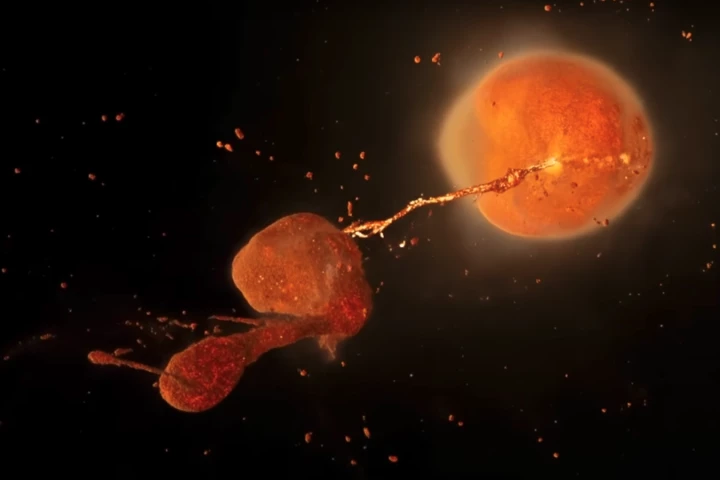 It’s believed that the Moon formed billions of years ago, from debris from a cosmic collision with Earth. New high-resolution simulations not only illustrate the idea in stunning detail, but reveal that the Moon’s birth might have taken mere hours.
 -
 Contrary to their name, black holes are known to fire off flares from time to time, but exactly how this happens is shrouded in mystery. High-resolution simulations have now revealed how twisting magnetic fields can throw off huge amounts of energy.
 -
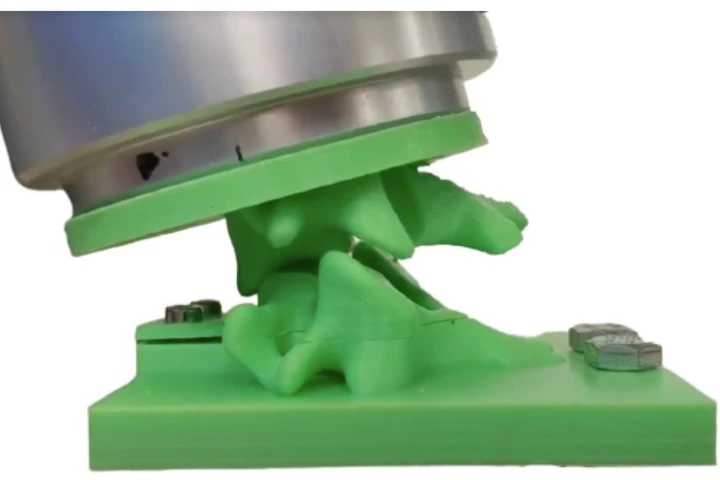 As people get older, the intervertebral discs in their spine tend to deteriorate, some of which end up being surgically replaced with implants. A new patient-specific spinal model, however, could help determine how successful such surgery will be.
 -
 If you've seen even a single shark documentary, then you've probably heard that the majority of attacks on humans are likely due to sharks mistaking people for seals. Scientists now say they've confirmed that theory, using computer models.
 -
 A collection of computer simulations based on data from NASA’s Chandra X-ray observatory is offering astronomers and the public alike the ability to explore cosmic objects in 3D. The visualizations let users pan around stars and supernovae remnants.
 -
 A new study has used simulations to show that even Earth-like planets completely encased in ice could still have areas warm enough for life, muddying up the already-murky definition of habitable worlds.
 -
 Last year astronomers discovered a gigantic “ghost” galaxy, named Antlia 2, orbiting the Milky Way. Now, new research led by Rochester University has found that the bizarre galaxy may have been involved in a hit-and-run that left the Milky Way with a wobbly galactic disc.
 -
 As the largest planet in the solar system by a wide margin, Jupiter has a lot of sway, but its history is still a bit of a mystery. Now astronomers have put forward a new theory, suggesting that the gas giant formed much farther away from the Sun and then migrated into its current position.
 -
 According to a new study, the Large Magellanic Cloud, a nearby dwarf galaxy, is on a collision course with the Milky Way. But there’s no need to worry just yet – the starry smashup won’t begin for another two billion years or so.
 -
 Among the almost-4,000 exoplanets found so far, none really capture the imagination like TRAPPIST-1. Now a team of astronomers led by the University of Washington has simulated the climates that could be found on each TRAPPIST world.
Load More