
Quantum-Information
-
 Movements at the particle scale happen extremely quickly, which makes it hard to see what’s going on in there. Now engineers have developed an “attoclock” that can take snapshots of electrons in increments as small as quintillionths of a second.
 -
 Physicists at the Max Planck Institute have developed an efficient new method to drive the quantum entanglement of photons, and demonstrated it by entangling a record number of photons. The technique could be a boon for quantum computers.
 -
 A quantum internet could one day allow quantum computers to team up and tackle some gigantic problems. Researchers at Toshiba are a step closer, demonstrating quantum communications sent over a record-breaking 600 km (373 miles) of optic fiber.
 -
 There’s no such thing as random in classical physics – for true randomization you need to turn to quantum physics. Now scientists have done just that, creating secure encryption keys based on the genuine randomness of quantum vibrations of diamond.
 -
 Progress on quantum computers may soon stall. Cosmic rays streaming to Earth can interfere with the integrity of information in quantum computers, and now an MIT team has shown just how vulnerable they are and what it might take to protect them.
 -
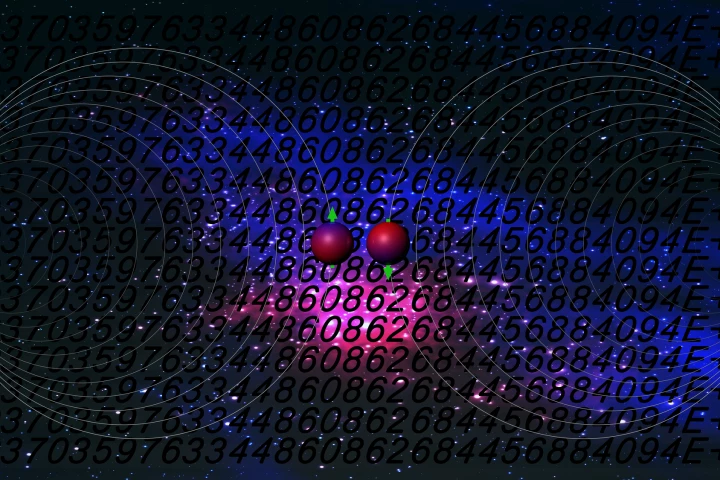 Scientists have achieved quantum teleportation between two computer chips for the first time, sending information between them without being physically or electronically connected. The feat opens the door for quantum computers and quantum internet.
 -
 Scientists from Austria and China throw Schrodinger's Cat for a loop.
 -
 The tractor beam is a long-time staple of sci-fi, but now Australian researchers have created a real-world version. While it won’t exactly be capturing enemy spaceships anytime soon, the device can use light to pull in and trap atoms, which may be handy for quantum communications or memory systems.