
Quantum Computing
-
 Scientists in Australia have used quantum computers to observe something usually too fast for the eye to see. The team managed to slow down a molecular interaction by 100 billion times to see what’s really going on in a common chemical reaction.
 -
 Scientists have detected the first evidence of a phenomenon called “quantum superchemistry.” Long predicted but never confirmed, this effect could speed up chemical reactions, give scientists more control over them, and inform quantum computing.
 -
 Scientists in South Korea have created what they call "the world’s smallest ball game," throwing individual atoms between two optical traps. The research could eventually make for more adaptable and dynamic quantum computers.
 -
 Wormholes are a sci-fi staple, and and it's possible that they exist in the real universe. But how would they work? Physicists have now used a quantum processor to simulate a traversable wormhole, teleporting information between two quantum systems.
 -
 Movements at the particle scale happen extremely quickly, which makes it hard to see what’s going on in there. Now engineers have developed an “attoclock” that can take snapshots of electrons in increments as small as quintillionths of a second.
 -
 The 2022 Nobel Prize in Physics has been awarded to three scientists, Alain Aspect, John F. Clauser and Anton Zeilinger, who all conducted some of the first experiments with entangled photons, enabling a future for commercial quantum computers.
 -
 Scientists have developed a way to produce a web of quantum entangled photons using a far more simple setup than usual. The key is a precisely patterned surface 100 times thinner than paper, which could replace a roomful of optical equipment.
 -
 Physicists at the Max Planck Institute have developed an efficient new method to drive the quantum entanglement of photons, and demonstrated it by entangling a record number of photons. The technique could be a boon for quantum computers.
 -
 Researchers have developed a more precise design for "optical tweezers," using a metasurface lens studded with millions of tiny pillars which focus light to trap and manipulate individual atoms. It could pave the way for powerful quantum devices.
 -
 Scientists have created a “quantum flute” that can coax photons to move in sync and interact with each other, which they almost never do in nature. The device could help improve future quantum computer designs.
 -
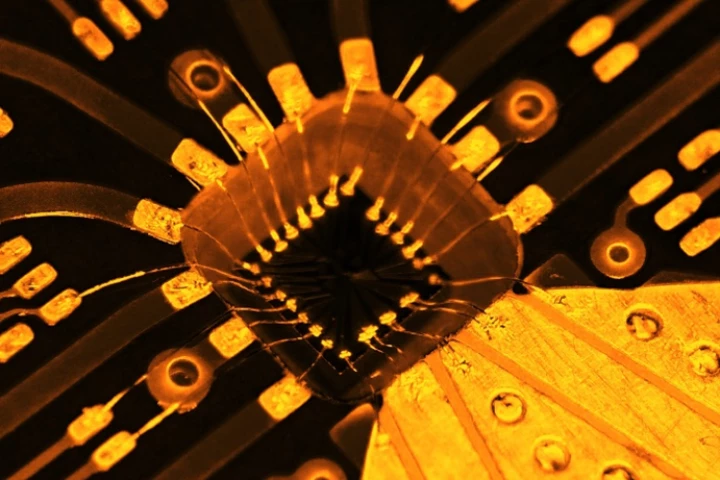 Three teams of scientists have achieved a major milestone in quantum computing. All three groups demonstrated better than 99 percent accuracy in silicon-based quantum devices, paving the way for practical, scalable, error-free quantum computers.
 -
 An exotic state of matter originally hypothesized almost 50 years ago has been observed for the first time. Created by Harvard researchers, this material called quantum spin liquid could eventually help improve quantum computers.
Load More