
Ozone
-
 As private companies make spaceflight routine, Earth’s upper atmosphere has become a testing ground with each launch leaving residues that react with ozone, thinning the layer that shields life below. It’s a problem scientists are just beginning to quantify.
 -
 And now for a spot of good news for our planet: the protective layer of ozone continues to heal, with the hole in our stratospheric shield having shrunk to a smaller size in 2024 than in the period between 2020-2023.
 -
 Climate change can feel inevitable, but we’ve stepped up to the challenge before. New modeling shows how bad things would be if CFCs hadn’t been banned decades ago – depleted ozone would've increased UV exposure and stopped plants capturing carbon.
 -
 An ancient tree fossil has offered scientists a peek into a moment 42,000 years ago when the Earth’s magnetic field went haywire. The study paints a picture of environmental chaos, influencing everything from an increase in cave paintings to the extinction of the Neanderthals.
 -
 For some time now, bacteria-killing ozone gas has been used to help heal chronic wounds such as diabetic skin ulcers. Such treatment could soon be a lot more practical and effective, thanks to an experimental new wearable system.
 -
 A new study has revealed that a cataclysmic disruption of Earth’s protective ozone layer may have allowed damaging levels of ultraviolet (UV) radiation to saturate the Earth 359 million years ago, triggering a global mass extinction.
 -
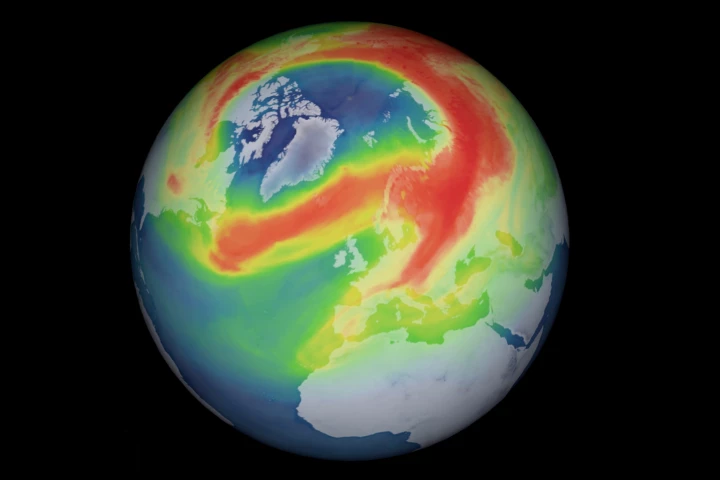 Although a hole in the ozone layer might sound like a retro environmental issue, it’s still a problem today. While it's usually over Antarctica, scientists have now spotted the biggest ozone layer hole in at least 25 years forming over the Arctic.
 -
 New research has found that each of us is regularly producing our own personal cloud of pollutants, affecting indoor air quality. But not the way you think. The team found that oils on our skin and clothes are reacting with ozone in the air, producing a range of volatile and semi-volatile substances
 -
 The hole in the ozone layer may be on the mend, but its environmental impacts are ongoing. A new review study has examined the effects that the extra UV radiation is having on the environment, such as shifting climate zones, changing ocean temperatures and making some species more vulnerable.
 -
 Around 30 years ago, the world came together to mend a widening hole in the Earth’s ozone layer, which plays a very important role in shielding us from ultraviolet rays. A new report has revealed that this long-term healing strategy is continuing to pay dividends.
 -
 A new study has revealed that ozone levels in the heavily populated lower latitudes don't seem to be recovering as well as regions near the poles. Although there isn't yet a clear explanation as to why this is happening, blame may still rest on short-lived ozone-destroying chemicals.
 -
 It’s long been known that the hole in the ozone layer is shrinking, but a new study has provided greater insight into the improving health of the ozone layer by analyzing the chemicals around the hole over the last decade or so.
Load More