
Orbit
-
 NASA has completed the analysis of a chunk of metal that crashed into the roof of a house in Naples, Florida, a few weeks ago. The agency says it came from a pallet of trash released from the International Space Station three years ago.
 -
 Solar wind – charged particles from the Sun – pervades our solar system, but the exact mechanism behind it remains murky. Now ESA’s Solar Orbiter spacecraft has observed previously unknown tiny flares on the Sun’s surface spewing plasma into space.
 -
 Rockets are expensive, so a number of kinetic launch startups are working on ways to simply yeet payloads into orbit and bring costs down. This one's very fun – a six-mile-long concrete cannon that'll squeeze launch vehicles to Mach 30 in one second.
 -
 While two thirds of exoplanets may be a fiery, boiling wasteland, scientists believe the other third occupy a "just right" goldilocks orbit around their star, and this, much like Earth's orbit, could provide the right environmental support for life.
 -
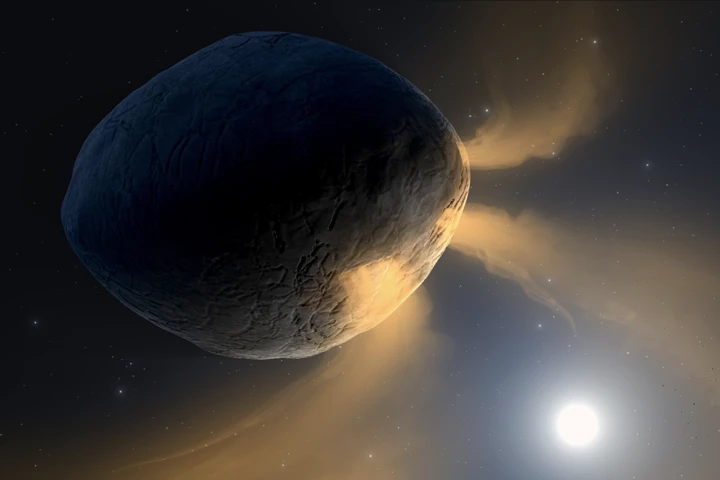 This space oddity has long puzzled scientists for its peculiar non-asteroid-like behaviors. Researchers have now uncovered another curious characteristic of 3200 Phaethon, this time with its dazzling tail, rewriting 14 years of science knowledge.
 -
 A new mathematical study suggests that the abandoned Ascent Stage of the Apollo 11 mission's Eagle Lunar Module, long believed to have crashed on the Moon in 1969, may be circling our largest natural satellite in a stable orbit.
 -
 NASA has completed a milestone test of the James Webb Space Telescope’s (JWST) sunshield, which will protect the flagship observatory from the Sun’s radiation as it unravels the secrets of the cosmos.
 -
 ESA has released a breathtaking mosaic of the Red Planet, stitched together from images taken by the Mars Express spacecraft.
 -
 If it was in our solar system, the orbit of exoplanet HR 5183 b would swing from the asteroid belt to way out beyond Neptune.
 -
 India's ambitious Chandrayaan-2 mission, which is comprised of an orbiter, a lander, and a rover, has successfully made orbit around the Moon.
 -
 With dozens of moons whizzing around Jupiter, it makes sense that a few have slipped under the radar, but the latest discovery is still a surprisingly large haul. Astronomers have announced the detection of 12 new moons orbiting Jupiter, including one particularly reckless “oddball.”
 -
 ‘Oumuamua is the first interstellar visitor ever detected passing through our Solar System, and while it was originally classed as an asteroid after its discovery, astronomers have now updated the label. ‘Oumuamua, it turns out, is a comet after all, but it’s unlike any other known comet.
Load More