
Observatory
-
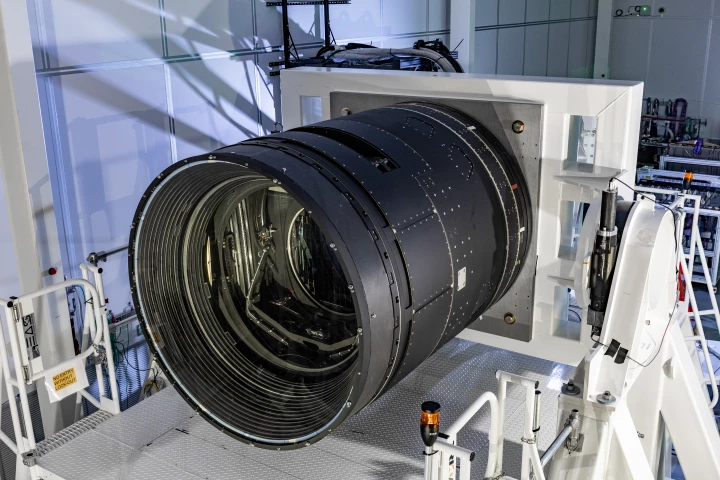 After decades of planning and building, the world's largest digital camera at the heart of the Vera C. Rubin Observatory on the summit of Cerro Pachón in Chile has snapped its first imagery – from test observations spanning a 10-hour window.
 -
 Earlier this year, it was reported that Earth was hit by the brightest gamma-ray bursts seen since the dawn of civilization. Now, a team of astronomers has assigned a value to the energy contained in those blasts and it's staggering to say the least.
 -
 Radio waves from Alaska have been transmitted to an asteroid passing just two lunar distances away from the Earth. The information gathered could arm scientists with information that may be critical in defending the planet from a collision some day.
 -
 The Arecibo Observatory's famous 1,000-ft (305-m) radio telescope is to be demolished after a second support cable failed. An assessment has determined that the radio dish and its 900-ton instrument platform are too unstable to be safely repaired.
 -
 Last week, the Earth had its closest shave with an asteroid ever recorded, when a small space rock skimmed just 370 km (230 miles) above the surface. For comparison, that’s closer than the orbit of the International Space Station.
 -
 The Super-Kamiokande neutrino observatory in Japan has received an upgrade. A rare-earth element called gadolinium has been added to the water in the facility, which will make it more sensitive to neutrinos from more distant and ancient supernovae.
 -
 A team of astronomers has identified what may be the best spot on Earth to stick a telescope. A high plateau in eastern Antarctica would have an exceptionally clear view of the stars, even outperforming other locations on the polar continent.
 -
 NASA has released a new panoramic infrared image of the center of the Milky Way. With data gathered by the Boeing 747-based SOFIA observatory, the image reveals new details of certain regions that have been traditionally tricky to capture.
 -
 Black holes are mysterious objects: just when we think we understand how big they can get, we go and find new ones that bend the rules. Now, astronomers have found a stellar black hole in our galaxy that’s so big it defies explanation.
 -
 If it was in our solar system, the orbit of exoplanet HR 5183 b would swing from the asteroid belt to way out beyond Neptune.
 -
 In 1974, astronomers used the Arecibo Observatory to beam a message from humanity to the stars, in one of the most well-known attempts to contact possible alien life. For the 44th anniversary of the Arecibo Message, scientists are reaching out to the public for help in designing an updated version.
 -
 A new exoplanet hunting tool has been installed onto an Australian telescope. Dubbed Veloce, the instrument looks out for the wobble of a star caused by the gravitational tug of orbiting planets, and it specializes in red dwarfs, the most common type of star in the universe.
Load More