
Oak Ridge National Laboratory
-
 Scientists have developed an efficient new way to convert methane into methanol at room temperature. The technique could help reduce greenhouse gas emissions and provide a cleaner way to make key products.
 -
 Carbon dioxide is an all too common waste product of industry, belched into the air from smokestacks. Now, researchers have developed a new type of fluorinated membrane that can selectively filter CO2 out of flue gas at the point of release.
 -
 Scientists have come up with a way to stop damaged lithium-ion batteries catching fire. The batteries effectively harden on impact, preventing the electrodes making contact and starting a fire.
 -
 Scientists are looking at how ultrasound can be used to dry laundry. They've already developed technology that they say could make clothes dryers 70 percent more energy-efficient than they are now.
 -
 Four new elements recently added to the periodic table have finally been given names suitable to their discovery and scientific field of relevance. Now the final decision as to whether these names become permanent has been opened to pubic comment.
 -
 You already know that water can have three states of matter: solid, liquid and gas. But scientists at the Oak Ridge National Lab (ORNL) have discovered that when it's put under extreme pressure in small spaces, the life-giving liquid can exhibit a strange fourth state known as tunneling.
 -
 Time to re-write the textbooks. The International Union of Pure and Applied Chemistry (IUPAC) has confirmed the existence of four new elements with the atomic numbers 113, 115, 117, and 118.
 -
 There may soon be a new use for discarded tires. Researchers from the US Department of Energy’s Oak Ridge National Laboratory have devised a method of harvesting the carbon black from them, and using it to make anodes for better-performing lithium-ion batteries.
 -
 A team of researchers is seeking to challenge the theory that the anode, cathode and electrolyte of a battery can only work independently, experimenting with a dual functioning electrolyte that supplements the cathode, resulting in a significant improvement of the battery's capacity and lifespan.
 -
 An international team of scientists has made a breakthrough in the magnetic manipulation of nanoparticles that could lead to a big boost for small scale digital storage in portable devices.
 -
 Researchers have created gold nanoparticles that allow an alpha particle-emitting element to be directed to small cancer tumors.
 -
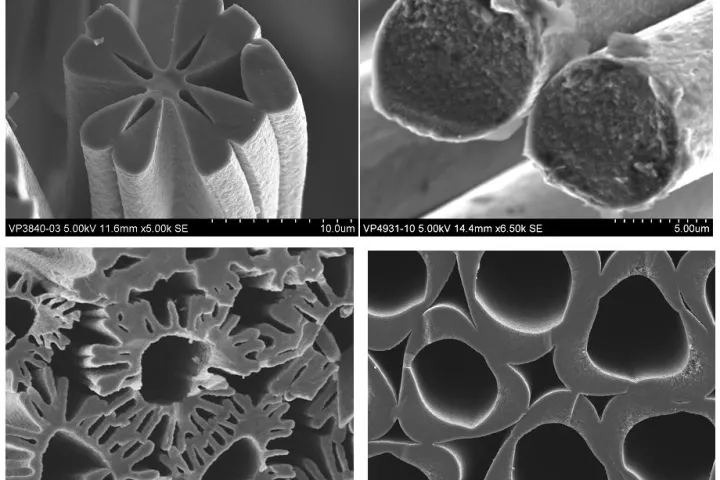 Scientists have created a method of producing carbon fiber from scrap polyethylene plastic.