
Nanoscale
-
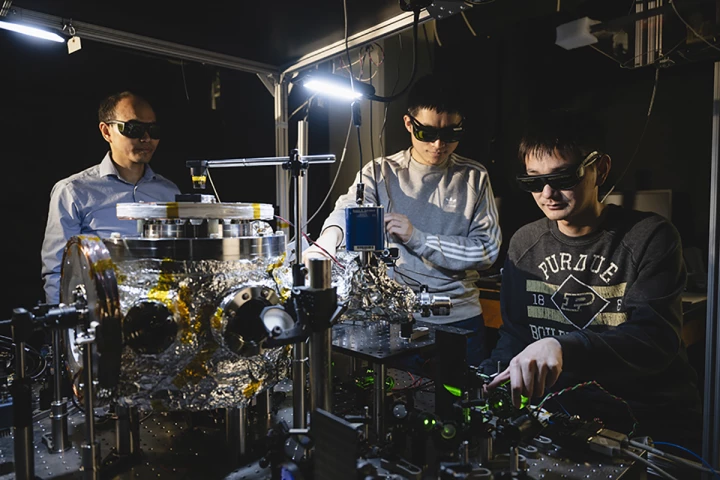 Physicists have levitated nanoscale diamonds, hit them with lasers to make them flash and spun them at an incredible 1.2 billion rpm. The experiments aren’t just about creating the “world’s smallest disco” but could help the study of quantum physics.
 -
 Researchers at Empa and EPFL have created one of the smallest motors ever made. It’s composed of just 16 atoms, and at that tiny size it seems to function right on the boundary between classical physics and the spooky quantum realm.
 -
 Researchers at the Queensland University of Technology (QUT) have used a new technique to produce detailed images of dragonfly wings, showing more than 10 billion tiny 'fingers' (nanostructures) lining the wing surface that make bacteria tear themselves apart.
 -
 A nano-scale engine made from tiny charged particles of gold has just been declared the world's smallest by researchers at the University of Cambridge who created it.
 -
 A team of physicists have just created the world's smallest working engine from a single electrically-charged atom. With an equivalent efficiency (if scaled to size) of an average automobile engine, it actually produces a significant amount of power
 -
 A long sought-after "nanograss" structure promises to significantly boost the efficiency of organic solar cells by capturing light more efficiently while also allowing the use of cheaper, lower-grade materials.
 -
 Using waste hemp fibers as the starting material, researchers at the University of Alberta in Canada have developed a high-performance electrode material for supercapacitors at one thousandth the cost of the more commonly used graphene.
 -
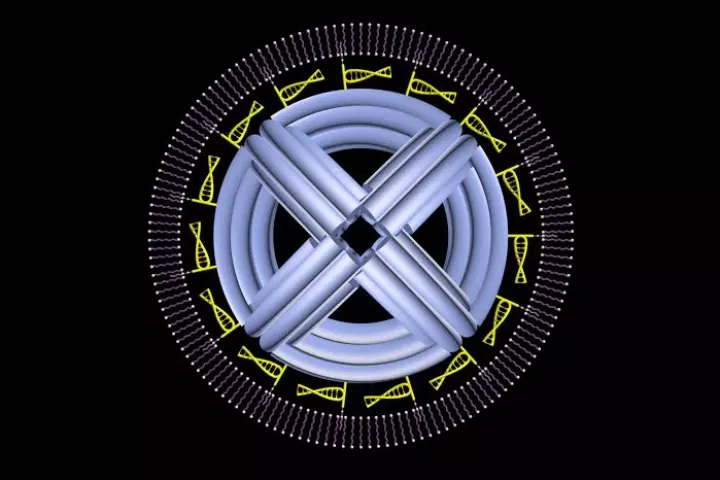 Researchers from Harvard University's Wyss Institute have developed a cloaked DNA nanodevice capable of evading the body's immune defenses. The design was inspired by real world viruses and could be used to diagnose cancer and better target treatments to specific areas of tissue.
 -
 Hotter things always release heat to their colder environments, correct? Researchers show that particles on a nanoscale actually fluctuate more than we expect on a macro scale and develop new procedures to test what exactly is happening on the level of our increasingly miniature technology.
 -
 Researchers have found that the nanoscale spikes that feature on the surface of black silicon can literally shred a wide range of bacteria, potentially paving the way for a new generation of antibacterial surfaces.
 -
 During the recent LEGO2NANO summer school held at Tsinghua University in Beijing, a group of Chinese and English students succeeded in making a Lego-based scanning atomic force microscope with nanoscale resolution in five days at a cost less than $500.
 -
 Researchers from Minnesota and Seoul have developed a novel nanolithographic technique based on atomic layer deposition and ... Scotch Magic tape. Materials made using this new method show hugely nonlinear optical properties and promise to enhance our ability to fabricate nanostructures.
Load More