
Microchip
-
 Ordinarily, the microcircuit patterns used in microchips are printed onto flat silicon wafers, potentially limiting their applications. A new technique lets such patterns be more easily applied to curved surfaces – and it uses "candy" to do the job.
 -
 Researchers at the University of Sussex claim to have produced a method that removes lasers from quantum logic gates, thereby removing one of the largest stumbling blocks to producing a workable, full-sized quantum computer system
 -
 Yale scientists have created a method to significantly increase the power of laser light on a silicon chip by boosting it with sound waves. This new device promises more efficient fiber-optic communications and better data signal processing
 -
 A new micro-ring resonator has been developed that is claimed to produce copious numbers of entangled photons using miniscule amounts of energy and can fit onto an ordinary silicon chip. This advance promises to bring quantum computing, communication, and cryptography closer to a practical reality.
 -
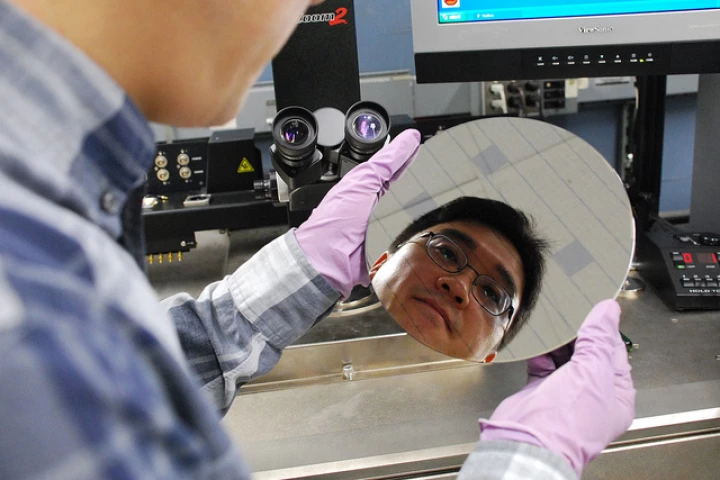 IBM researchers have succeeded in creating a chip with transistors made from carbon nanotubes, instead of the traditional silicon.
 -
 Researchers have built an “inexact” prototype silicon chip that is allowed to make the occasional mistake, but which they claim is at least 15 times more efficient than current technology in terms of speed, energy consumption and size.