
Meteor
-
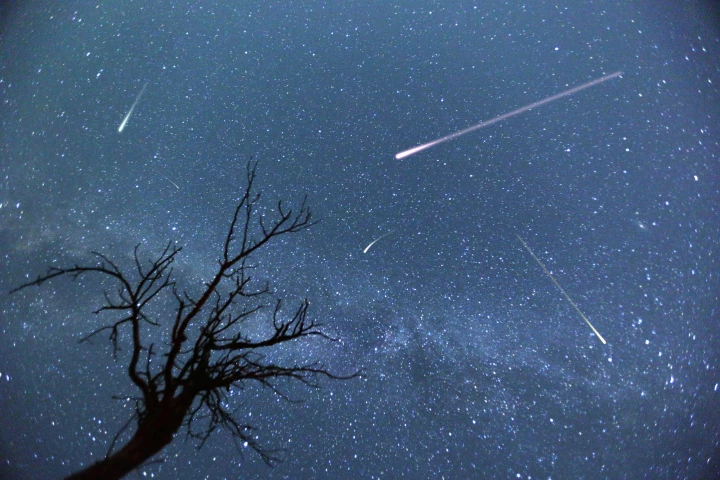 Despite making up 85% of the total mass in the universe, dark matter eludes detection. A new study proposes a unique way to look for it using the Earth’s atmosphere as a giant detector for dark matter particles streaming through the air like meteors.
 -
 An international team has found a massive collection of fossils of fish and other animals in North Dakota that were killed by a seismic sea wave and a shower of burning glass beads less than an hour after the asteroid strike 66 million years ago off the shore of what is now Yucatan.
 -
 Scientists have found an ancient meteor crater under the Greenland ice cap that's larger than Paris. Discovered using ground-penetrating radar, the possibly three-million-year-old impact crater is 19 miles in diameter, about 1,000 ft deep, and is buried under 3,200 ft of glacial ice.
 -
 A new study suggests that we may be searching in the wrong place for signs of life on Mars when we examine rocks excavated by meteor impacts for organic compounds.
 -
 Researchers have estimated that around 3.5 billion years ago, Mercury underwent its final major burst of volcanic activity. The results of the study will help scientists understand how Mercury evolved into the scorched planet we know today.
 -
 An international team of researchers has calculated the cataclysmic conditions created when an asteroid struck northern Arizona roughly 49,000 years ago by analyzing the structure of microscopic diamonds known as zircons.