
Mars Express
-
 A massive volcano has been hiding in plain sight on Mars, says new research. Not only is its sheer size noteworthy, but the team believes it might also harbor glacial ice that could be critical for further exploration and Martian settlements.
 -
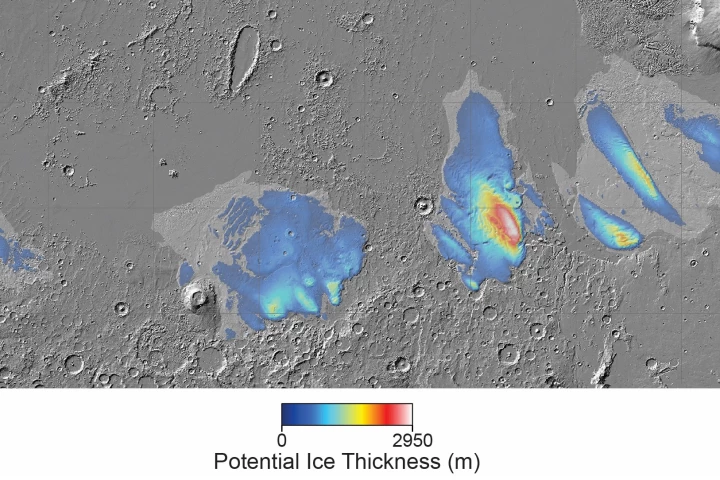 Data from ESA's Mars Express indicates that there may be subterranean ice deposits at the Martian equator that are up to 2.3 miles (3.7 km) thick. With enough water to fill the Red Sea, this could be a tremendous resource for future Mars colonies.
 -
 By conducting "flybys" of Phobos when it wasn't actually there, ESA's Mars Express orbiter provided researchers with a controlled experiment to learn more about the mysterious, intermittent interaction between the Martian moon and solar winds.
 -
 By studying the logs of computer malfunctions caused by high-energy particles striking their circuitry, ESA scientists have used "housekeeping" data from the Rosetta and Mars Express deep-space probes to shed new light on cosmic rays in the solar system.
 -
 ESA's Mars Express spacecraft has captured a rare movie of the Martian moon Phobos. The moon is set to be the target of an international mission to survey the Red Planet’s two natural satellites, and return a surface sample to Earth.
 -
 ESA has released a breathtaking mosaic of the Red Planet, stitched together from images taken by the Mars Express spacecraft.
 -
 The ExoMars Trace Gas Orbiter (TGO) has made a map of the distribution of watery minerals in the Martian surface, studied how the global dust storm affected the atmosphere, and intriguingly found very little methane, which calls into question the results of a study just last week.
 -
 The Red Planet is notoriously dry and dusty, but its scarred surface shows that that wasn’t always the case. A new set of photos from the ESA's Mars Express orbiter demonstrates some pretty clear evidence of an ancient river network that once wound across the Martian landscape.
 -
 Christmas Day 2018 marks the 15th anniversary of ESA's Mars Express orbiter arriving at the Red Planet and to mark the occasion the space agency has released a suitably festive image of a crater that seems filled with fresh snow. It's of Korolev Crater and it's filled with perpetually frozen ice.
 -
 A huge lake of liquid water has been found on Mars. The groundbreaking discovery marks the first time a significant amount of the life-giving liquid has been detected. Discovered through satellite radar readings, the lake lies beneath the ice caps at the south pole of Mars.
 -
 The latest image from the Mars Express orbiter, just released by the European Space Agency, was taken on the 19th June, 2017 and shows a rare upside-down, wide-angle view of Mars with its icy northern polar cap at the bottom.
 -
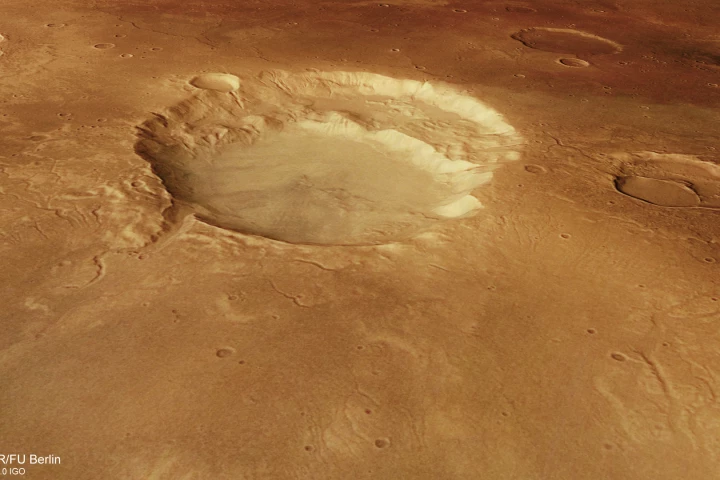 ESA's Mars Express orbiter has captured images that may indicate the presence of supervolcanoes on the surface of Mars. If the findings are later confirmed, the existence of these leviathan volcanoes may greatly inform current theories on climate formation.
Load More