
Los Alamos National Laboratory
-
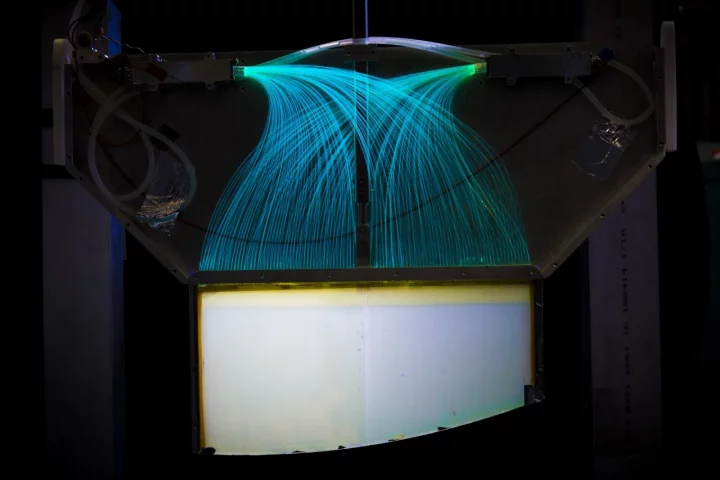 Physicists have measured the lifetime of a free neutron more precisely than ever before. This breakthrough "bathtub" experiment helps probe the fringes of the Standard Model of particle physics, and mysteries like dark matter and the early universe.
 -
 Scientists have uncovered some new details about the heliosphere. They've produced the first ever map of its boundary, called the heliopause, where solar winds are brought to a stop by the interstellar medium.
 -
 Scientists have discovered a strange new form of crystal that was forged in the first nuclear weapons test. Known as a "quasicrystal," the curious creation is made out of desert sand and copper wiring arranged in an extremely rare atomic structure.
 -
 Which time travel movie got the rules right? According to experiments using a quantum time travel simulator, reality is “self-healing,” so changes made to the past won’t drastically alter the future you came from – at least, in the quantum realm.
 -
 It looks as if the days of the venerable explosive TNT are numbered as researchers at the Los Alamos National Laboratory (LANL) and the US Army Research Laboratory in Aberdeen, Maryland develop a new explosive that has the power of TNT, yet is safer and more environmentally friendly.
 -
 Strides have been made in the last few years to develop solar windows. Known as luminescent solar concentrators, these haven’t proven efficient or scalable, but now researchers have demonstrated a new technique that could make for larger, more practical solar energy-harvesting windows.
 -
 Scientists at Los Alamos National Laboratory in the US have confirmed a 7.68 oz (217.78 g) piece of gold is in fact a singular crystal. The specimen was discovered in Venezuela decades earlier, but it is only by using an advanced probing instrument can experts now verify its authenticity.
 -
 The ATHENA project, which is developing a "desktop human" for for screening both new drugs and toxic agents, has reported success in the development of its first organ construct, a human liver construct that responds to exposure to a toxic chemical much like a real liver.
 -
 Los Alamos National Laboratory is developing a new small reactor for spacecraft that uses uranium instead of plutonium.