
Lenses
-
 Contact lenses get pretty thin nowadays, but they’ve got nothing on a new lens from scientists at Stanford and the University of Amsterdam. The team has created the world’s thinnest lens, measuring just three atoms thick.
 -
 Researchers have developed a flat lens that's one one-thousandth the thickness and one one-hundredth the weight of a conventional model.
 -
 Presbyopia is a common form of age-induced far-sightedness. Now a Stanford team has developed a pair of high-tech specs called autofocals, which use fluid-filled lenses, depth-sensing cameras and eye-tracking technology to make sure whatever a wearer is looking at stays sharp.
 -
 A team from the Swinburne University of Technology are developing a graphene microlens one billionth of a meter thick that can take sharper images of objects the size of a single bacterium
 -
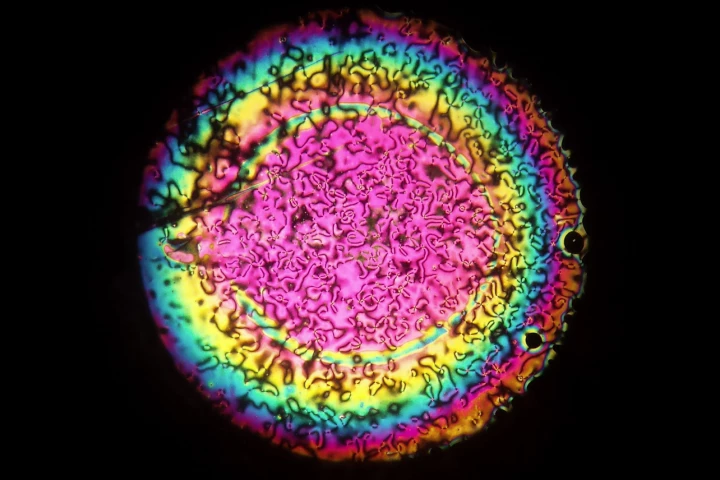 A new fully-adjustable synthetic eye lens from the University of Leeds, and made from liquid crystal, is designed to surgically replace long-sighted lenses in the human eye.
 -
 Two scientists at the University of Rochester have taken invisibility cloaking back to basics. Their novel arrangement of four standard, off-the-shelf lenses keeps an object hidden (and the background undisturbed) as the viewer moves up to several degrees away from the optimal viewing angle.
 -
 The US Department of Energy's Pacific Northwest National Laboratory has developed a smartphone attachment, that turns the phone into a 1,000x microscope. What's more, it's made from less than one dollar's worth of material.
 -
 Microscope lenses are typically made either by grinding and polishing glass discs, or pouring polymers into molds. Now, however, a scientist from Australian National University has devised a new lens-making process, in which drops of silicone are simply baked in an oven.
 -
 Scientists at the University of Pennsylvania have grown liquid crystal flowers, making it possible to create lenses as complex as the compound eye of a dragonfly. The technology could enable lenses to be grown on curved surfaces and building new materials, smart surfaces, microlens arrays, and more.
 -
 An experimental lens developed by scientists at Ohio State University that combines the wide angle properties of insect vision with the depth-of-field capabilities of a human eye could have wide ranging applications in devices such as microscopes and smartphone cameras.
 -
 When you feel you are outgrowing your starter model, buying a new telescope isn't the only option. Carefully selected of eyepieces can enhance your stargazing experience on an entry-level 4 to 6-inch telescope without blowing the budget.
 -
 Researchers have developed a telescopic contact lens with switchable magnification to assist people suffering from age-related macular degeneration.
Load More