
Lawrence Livermore National Laboratory
-
 A frothy breakthrough at Lawrence Livermore National Laboratory (LLNL), using lasers with a silver metal foam that's as light as air, has created the brightest yet X-ray source ever, twice as brilliant as that of anything previous.
 -
 Scientists have recreated in the lab some of the wild weather that might be found on Jupiter and Saturn. Using extremely high pressures and laser shock waves, the researchers produced helium rain which has been hypothesized to fall on these planets.
 -
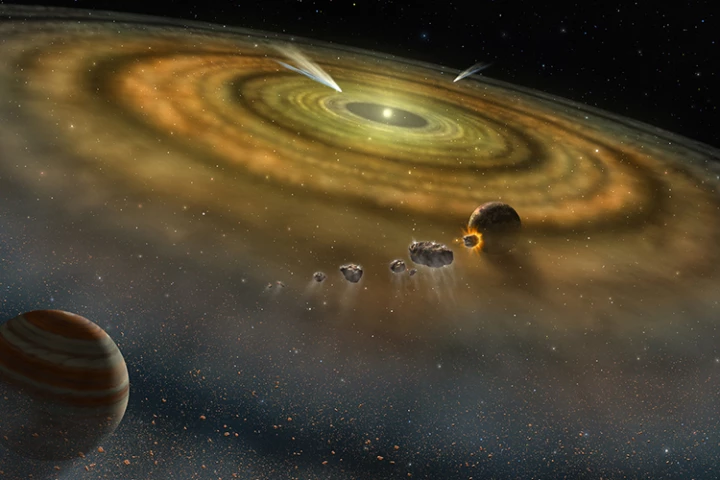 Based on isotope analysis of meteorites, scientists at the Lawrence Livermore National Laboratory have determined that our solar system may have formed much faster than previously thought.
 -
 Analysis of Saturn’s interior describes jet streams that continue deep below the surface and thick liquid that “flows like honey”.
 -
 How safe would you feel, going back into a multi-story building that had just been through an earthquake? A new sensor system could allay your fears, as it optically measures how much a building has swayed, and thus how damaged it may be.
 -
 Scientists from Lawrence Livermore National Laboratory's Forensic Science Center and Michigan State University have established that it's possible to identify a person from a single hair taken from anywhere on the human body.
 -
 A white dwarf is one of the last stages of life for stars of a certain size, and it’s all downhill from there. But supercomputer simulations run by astronomers at LLNL suggest that these dying stars could be reignited by a close encounter with an enigmatic class of black hole.
 -
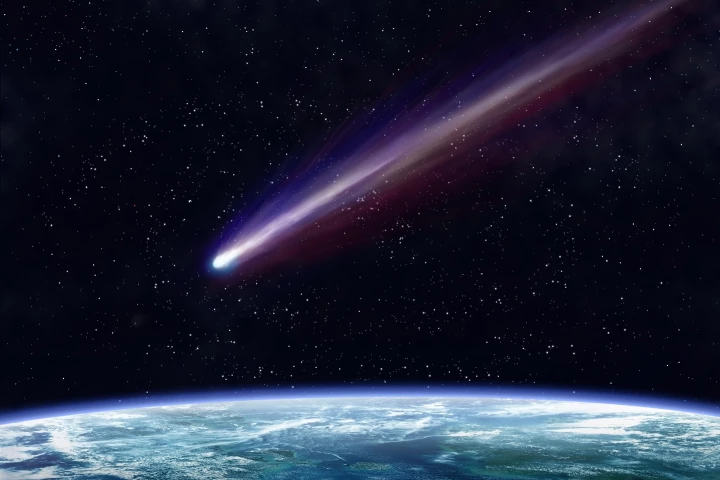 A partnership of scientists has been studying a conceptual spacecraft called the Hypervelocity Asteroid Mitigation Mission for Emergency Response (HAMMER) vehicle, designed to deflect dangerous asteroids before they reach us.
 -
 The US government has just released 62 newly declassified videos showing footage of atmospheric nuclear tests from the first half of the 20th century. The videos, never before seen by the general public, have been uploaded to YouTube.
 -
 It's one of the basic facts of science: Heat something and it expands. But a team of scientists from LLNL have gone counterintuitive and invented a 3D-printed material that shrinks when heated.
 -
 Four new elements recently added to the periodic table have finally been given names suitable to their discovery and scientific field of relevance. Now the final decision as to whether these names become permanent has been opened to pubic comment.
 -
 Time to re-write the textbooks. The International Union of Pure and Applied Chemistry (IUPAC) has confirmed the existence of four new elements with the atomic numbers 113, 115, 117, and 118.
Load More