
Juno
-
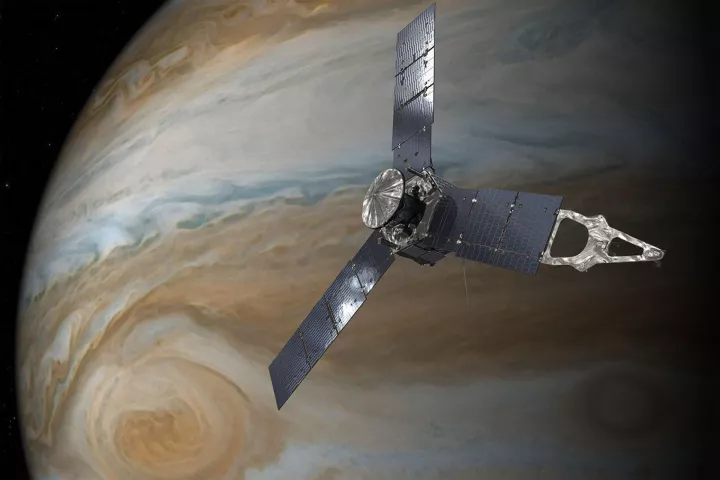 Using the thermal equivalent of giving it a sharp whack, NASA repaired the camera of its Jupiter-orbiting Juno probe from 370 million miles (590 million km) away after the instrument was put out of commission by the gas giant's radiation belts.
 -
 Data from NASA's Juno Jupiter orbiter suggests that the Jovian moon Europa produces about 26 lb/s (12 kg/s) of oxygen or almost 100 times less than previously estimated. This changes the probability of life being found in the moon's subterranean ocean.
 -
 NASA has released a high-resolution image taken by the Juno deep space probe during its close encounter with Jupiter's moon Io on December 30, 2023. The image of the volcanic satellite not only shows remarkable details, but an unusual kind of lighting.
 -
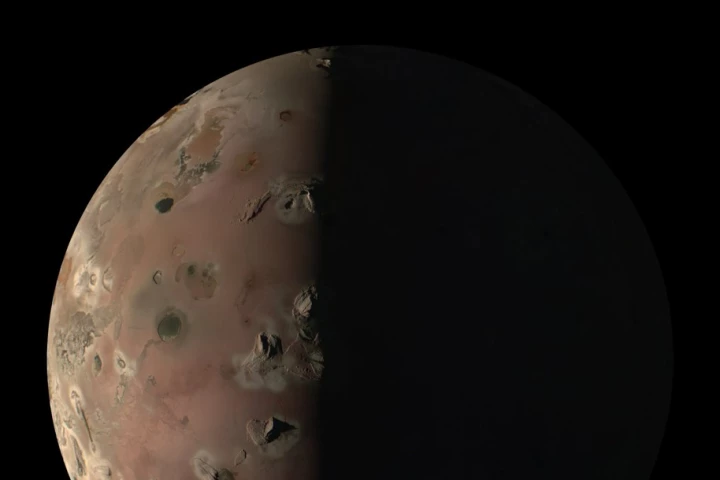 On December 30, 2023, NASA's Juno deep space probe made the closest flyby of Jupiter's moon Io in over two decades. The robotic spacecraft passed within 930 miles (1,500 km) of the volcanic satellite, returning closeup images of the south pole.
 -
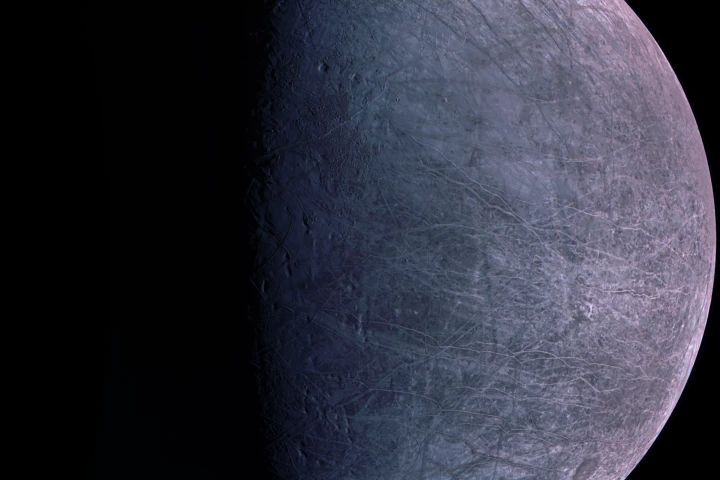 While NASA’s Juno spacecraft has captured some stunning imagery and compelling data on Jupiter since entering orbit around the gas giant in 2016, it’s not the only celestial body in the probe’s sights, now revealing more about its moon, Europa.
 -
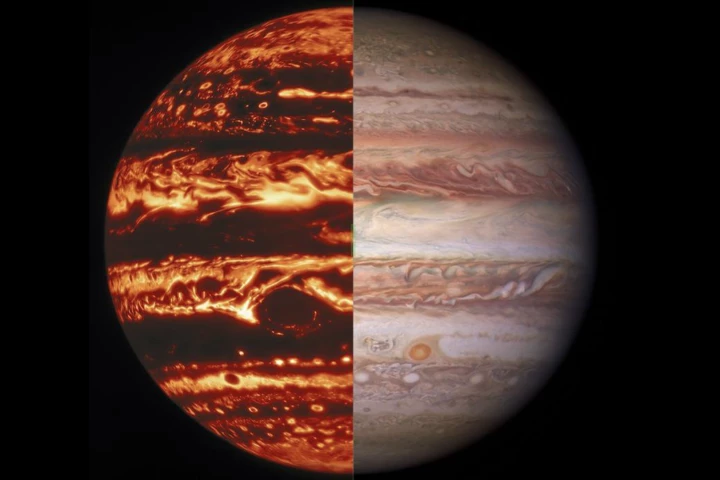 The latest data from NASA's pioneering Juno probe has offered the most complete picture of Jupiter's famously colorful and chaotic atmosphere yet, producing what scientists call the first 3D picture of the Jovian atmosphere.
 -
 NASA’s Juno spacecraft will take a Cassini-like approach to exploring the Jovian system when it begins its latest mission extension in August this year at which point it will make passes of Jupiter’s rings and moons, and explore key surface features.
 -
 Home to constant turbulent weather and the Great Red Spot – a storm bigger than Earth – Jupiter is the storm capital of the solar system. Now NASA’s Juno mission has discovered two new quirks of these storms – shallow lightning and “mushball” hail.
 -
 Using what is known as the “lucky imaging” technique, scientists have created one of the sharpest infrared images of Jupiter ever taken from Earth, helping to reveal its weather systems, lightning and iconic Great Red Spot in exciting new detail.
 -
 In this series New Atlas profiles space probes, both past and present, tasked with pushing the boundaries of science by leading us into the great unknown. This week: a spacecraft built to unravel the mysteries hiding behind Jupiter's colorful clouds.
 -
 Data from the Juno probe found that Jupiter's core is less dense and more spread out than expected. Now, astronomers believe they have an answer – a huge ancient planet, with 10 times the mass of Earth, crashed into the gas giant in the early days of the solar system.
 -
 Jupiter, the largest planet in our solar system, has recently delivered a mind-bending torrent of amazing images, Over the past twelve months we have been treated to some of the best images yet including a magnificent shot of a cloud in the shape of a dolphin, swimming over the Jovian surface.
Load More