
James Cook University
-
 A new study has found that the contents of commercially produced extracts used to test for shellfish allergies differ widely between manufacturers. The researchers say the lack of standardization increases the risk of false negatives.
 -
 For many, the idea of having a few dozen hookworms set up shop in your gut sounds more like a Survivor challenge than a beneficial health therapy, but scientists see a bright future in the human worm farm's ability to protect against chronic disease.
 -
 Climate change already appears to be responsible for an overabundance of jellyfish in the world's oceans, but new research indicates that it may also lead to something else – lots and lots of squid. The findings run contrary to what was expected to be the case.
 -
 Sharks are in the ocean and piranhas are in freshwater … right? Well, it turns out that 150 million years ago, the sea was also home to a piranha-like fish known as Piranhamesodon pinnatomus. The recently-classified creature is officially the earliest known flesh-eating ray-finned fish.
 -
 A team of scientists mapping the seafloor along Australia's Great Barrier Reef have stumbled upon the remains of a huge underwater landslide. Its estimated 32 km cubed volume is around 30 times that of Uluru, the giant red rock in Australia's center.
 -
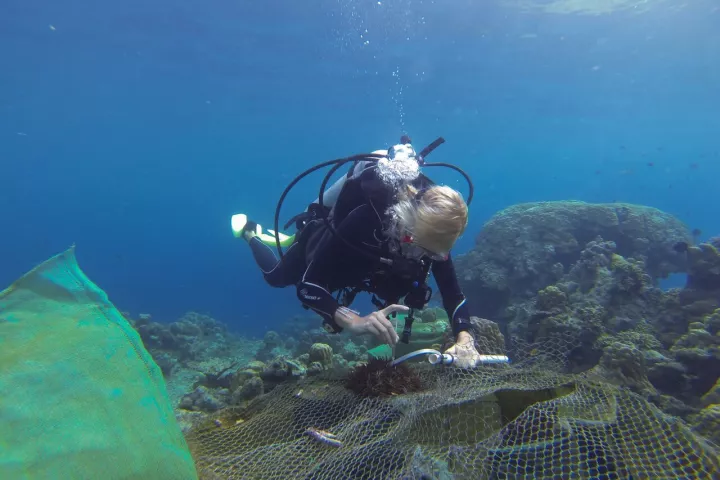 The crown-of-thorns starfish poses a major threat the wellbeing of the Great Barrier Reef. But researchers have now discovered that a dose of vinegar can kill them off, promising to significantly cut the cost of an expensive battle to rid a World Heritage Site of this damaging pest.
 -
 Scientists in Australia are looking at the manner in which a particular type of gecko is able to stay clean. Their findings could pave the way for things like water-repelling electronics, or clothes that never need washing.