
Helium
-
 A US startup is looking to our closest satellite to fill a resources gap here on Earth. Interlune and partner Vermeer have revealed a full-scale excavator prototype that forms a key component of its lunar resource Harvester.
 -
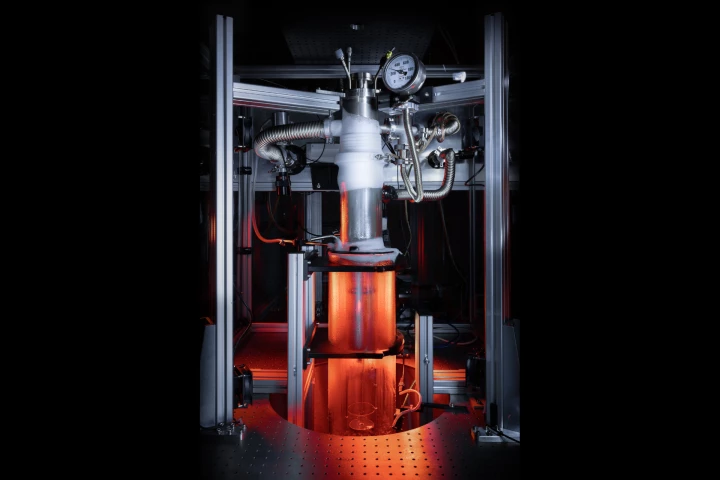 A giant quantum vortex has been created in superfluid helium in a lab at the University of Nottingham. Its behavior was found to mimic that of black holes and may help astrophysicists gain deeper insight into these galactic gravity gobblers.
 -
 Scientists from Caltech and WHOI have found evidence that Earth’s core is leaking. High levels of a particular isotope of helium were found in lava flows in Canada, which the team proposes originated in the planet’s core.
 -
 Astronomers have discovered a new type of star, which could be key to solving a cosmic mystery. This massive helium star has an ultra-strong magnetic field, meaning it could be the preliminary stage of a magnetar, which so far has unknown origins.
 -
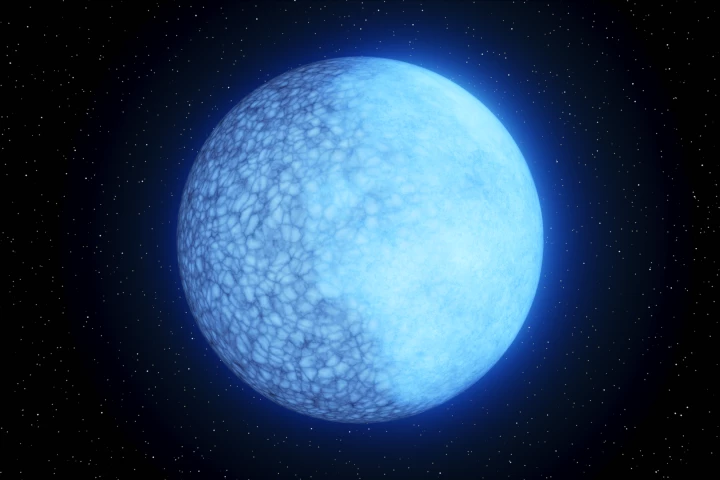 The ingredients in stars are usually pretty evenly mixed throughout, but now astronomers have discovered a bizarre star with two distinct faces, each made of a different element, which defies explanation.
 -
 Scientists have recreated in the lab some of the wild weather that might be found on Jupiter and Saturn. Using extremely high pressures and laser shock waves, the researchers produced helium rain which has been hypothesized to fall on these planets.
 -
 NASA astronomers have managed to probe the atmosphere of GJ 3470 b, a planet unlike any in our solar system. It marks the first time for this kind of world, and could be a step towards identifying potentially habitable planets.
 -
 Astronomers have finally found the very first molecule to ever form in the universe. The helium hydride ion (HeH+) has long been a key theoretical part of how the chemistry of the cosmos kicked off. Now the first unambiguous evidence of the molecule in a planetary nebula has been found.
 -
 The Sun was far more active in its early years, but we only really know this from studying other similar stars. Now, researchers have found the fingerprints of this active young Sun in tiny, bright blue crystals preserved in meteorites from a collection at Chicago’s Field Museum.
 -
 Eighty-five percent of all matter is dark matter, a theoretical substance that doesn’t interact with ordinary matter and has so far eluded our best efforts to directly detect it. Now physicists have proposed a new way to find dark matter using a huge tub of helium in a superfluid state.
 -
 When most people think of helium, they think of party balloons and funny voices, but the gas has far more important applications in medicine and electronics. Unfortunately, the world has been in the grips of a global shortage. Now, a research team has discovered a massive reserve in East Africa.